



A report by the NGO network Climate Action Network proposes a series of concrete changes to revitalise the UN Climate Change Conferences.
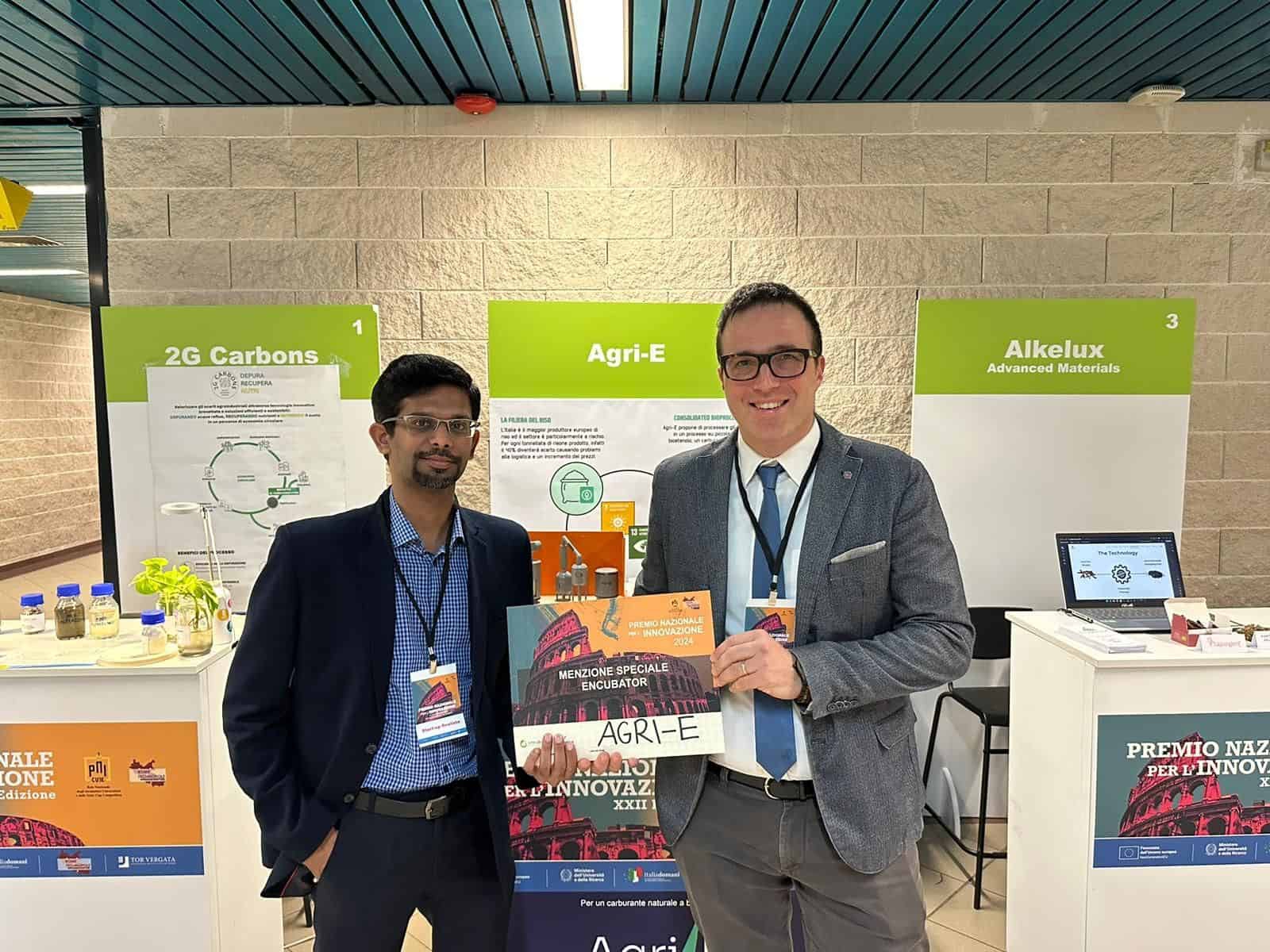
The solution developed by the Italian startup Agri-E enables on-site bioethanol production, promoting energy self-sufficiency for farms.
Turning rice waste into bioethanol, to achieve energy self-sufficiency for farms.
Agriculture is a key sector for the Italian economy, yet it has been facing increasingly demanding challenges for years. One of the biggest ones is the need to reduce environmental impact while also keeping energy costs under control.
Agri-E is an Italian startup aiming to offer a practical solution for agricultural businesses, grounded in the principles of sustainability and circularity. Its goal is to enhance local resources and minimize waste.
The startup seeks to provide farms with stable energy costs, reducing their dependence on the volatility of oil prices.
Relying on their strong technical and biotechnological expertise, the four members of the Agri-E team – Lorenzo Favaro, Ameya P. Gupte, Rosemary Cripwell, and Rebecca My – started by tackling the core issues of the agricultural sector. Among them, the four billion liters of diesel consumed annually by the industry, with fuel accounting for up to 18 per cent of a farm’s total operating costs. Added to this is the issue of price volatility: in the past five years alone, fuel prices have fluctuated by as much as 145 per cent between the lowest and highest values.
From the startup’s perspective, transforming rice waste – and in the near future, also potato and wheat residues – into bioethanol can offer to the farming industry a tangible and sustainable alternative to fossil fuels, while significantly reducing CO2 emissions.
The major innovation proposed by Agri-E lies in its cutting-edge Consolidated BioProcessing technology, which enables efficient and low-cost biofuel production by eliminating the need for commercial enzymes. Agri-E has developed a yeast capable of converting agricultural waste into biofuel in a single step.
A low-tech approach which allows miniaturized plants to directly valorize local waste, making individual farms energy self-sufficient. The system is highly scalable and can be adapted to meet the specific energy needs of each farm.
The waste, once ground, is placed in the fermenter together with the yeast and fermented for 48 hours.
The mixture then moves to the distiller, which separates the ethanol in less than five hours. Lastly, the ethanol is stored in a tank to use as fuel for machinery.
This streamlined and straightforward process aims to be more efficient and less costly than traditional methods. According to the startup’s founders, the bioethanol produced with Agri-E could cost up to fifty per cent less than conventional agricultural diesel.
Agri-E was awarded by LifeGate Way during the Startup & VC Plenary at the We Make Future festival, receiving exclusive services including consulting and communication support for its innovative idea.
Producing their own fuel directly from production waste, instead of relying on external supplies and on fluctuating prices, it can represent a great opportunity for growth and development for farms.

Siamo anche su WhatsApp. Segui il canale ufficiale LifeGate per restare aggiornata, aggiornato sulle ultime notizie e sulle nostre attività.

Quest'opera è distribuita con Licenza Creative Commons Attribuzione - Non commerciale - Non opere derivate 4.0 Internazionale.
A report by the NGO network Climate Action Network proposes a series of concrete changes to revitalise the UN Climate Change Conferences.
Pescasseroli, in the heart of Italy’s Apennines, will host the IBA conference on bear conservation and human–bear coexistence. LifeGate will be the event’s media partner.
The inflation caused by extreme weather events is known as “climateflation”: prices for many food products are expected to rise sharply.
The toll is still provisional, but data collected across several European countries indicate that tens of thousands of people have died as a result of extreme heat.
Last February, Malaysia imposed a total ban on electronic waste imports. Yet toxic e-waste continues to arrive from the United States and other countries through illegal trafficking networks.
Although Earth Overshoot Day falls six days later than in 2025, this does not represent an improvement. The shift is the result of revised estimates of the oceans’ carbon absorption capacity, while humanity’s actual ecological footprint continues to grow.
Gigantic wildfires in France’s Gironde region and near Madrid, Spain, have devastated tens of thousands of hectares of vegetation.
Greece has launched a wildfire management system based on nanosatellites and artificial intelligence. A model that other countries are now looking to replicate.
According to analysts, the emergence of a “super” El Niño could trigger a global food price shock, adding to inflationary pressures already fuelled by the conflict with Iran.


