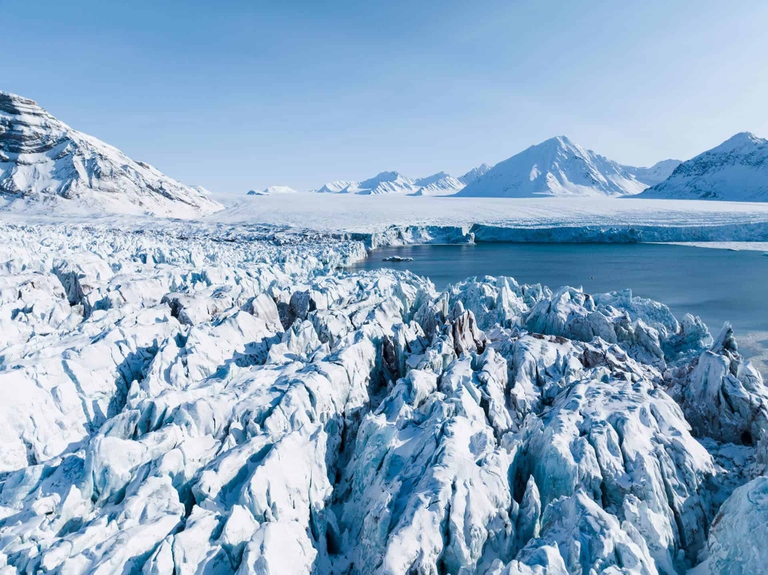
The Arctic has experienced the warmest year since regular measurements began. Never before had the average temperature in the polar region been so high, according to the US National Oceanic and Atmospheric Administration (Noaa): a full 1.6 degrees Celsius above the 1991–2020 average.
“Never like this in recent times, and perhaps not for thousands of years”
The data, covering the twelve-month period between October 2024 and September 2025, are contained in NOAA’s annual Arctic Report Card, which draws on historical series dating back to 1900. The finding has been described as “alarming” by Tom Ballinger, one of the study’s authors.
Speaking to the AFP news agency, the scientist said the trend appears to be “unprecedented in recent times and perhaps even over thousands of years.” It is now well established that the effects of global warming are significantly more pronounced in the Arctic region. This represents a major problem, as it accelerates the melting of polar ice caps, fuelling sea-level rise, which in turn will progressively submerge large coastal areas around the world, causing severe economic damage and mass displacement.
Growing risks for the Amoc ocean circulation
Moreover, the melting of polar ice also contributes to altering ocean circulation in the North Atlantic. The influx of fresher, less dense water hinders the functioning of the Amoc system—short for Atlantic Meridional Overturning Circulation—a complex mechanism involving numerous deep and surface currents.
Our article for this year's Arctic Report Card was just published and can be found at https://t.co/KK0NMfTtD3 (#OpenAccess). Using data from OISSTv2.1, we document the latest trends and variability in summertime ocean temperatures (with a particular focus on regional anomalies). pic.twitter.com/jkvojoL4Co
It can be compared to the boiler of a residential building: warm water flows northward, loses heat at high latitudes, and then returns southward as colder water. The Amoc depends precisely on differences in water density and plays a crucial role in the global climate system, particularly for Europe.
Record low Arctic ice extent in March
This is why the pace of Arctic warming is so worrying. The year examined by NOAA includes the warmest autumn on record, the second-warmest winter, and the third-warmest summer. In particular, March 2025 saw an unprecedented retreat of Arctic sea ice, reaching the lowest winter extent since satellite observations began.
On 22 March, ice cover fell to just 14.33 million square kilometres, according to the US National Snow and Ice Data Center (Nsidc): the lowest level in more than eighty years.
Rainfall and heat are greening the Arctic (and Antarctica too)
In addition, during the same October 2024–September 2025 period, precipitation reached record levels. The year ranks among the five wettest since 1950. Combined with higher temperatures, this has led to an expansion of vegetated areas. The same phenomenon has also been observed in Antarctica, where in the region between Cape Adams and the Eklund Islands, green-covered areas are now fourteen times larger than they were in 1986.
The oil giant TotalEnergies must defend itself against accusations of failing to take into account the climate consequences resulting from the use of its products.
From Australia to the United States, from Chile to Mozambique, and from Russia to Argentina, many countries are grappling with extreme weather conditions.
A Greenpeace report denounces Russia’s political and economic model: a nexus of extractivism, authoritarianism and war that is destroying the environment, with serious repercussions for the global ecosystem.