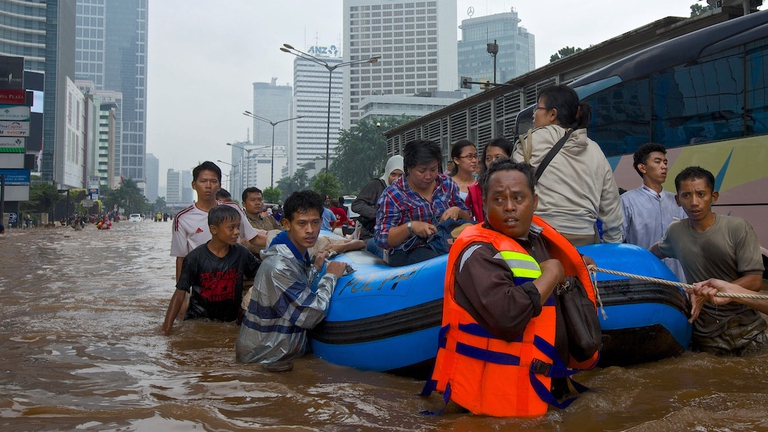
The world’s largest megacity is a city that is sinking: Jakarta. Indonesia’s capital now has 42 million inhabitants, overtaking Dhaka (Bangladesh), with around 40 million, and Tokyo (Japan), which is close to 33 million. This is a deeply alarming figure, given that the vast Indonesian urban centre is severely affected by the impacts of climate change.
According to a new UN report, Jakarta is now the world's most populous city, with nearly 42 million inhabitants.
The 2022 decision to move the capital from Jakarta to Nusantara
Torrential rains and tsunamis have been affecting Jakarta for years. As early as 2019, the Indonesian government began considering a drastic solution: relocating the capital outside the island of Java.
The decision was formally taken in 2022, with the announcement of the new seat of government: Nusantara. For now, little is known beyond the name, as it will be a new city built from scratch, located on the island of Borneo, about 2,000 kilometres from the current capital.
“By analysing our models, we can state that by 2050 around 95 per cent of northern Jakarta will be submerged,” explained Heri Andreas, a land management expert, speaking to the BBC in August 2018. The situation is particularly critical because around 40 per cent of Jakarta’s territory already lies below sea level.
Undesa: “45 per cent of the world’s population now lives in cities”
The report that has effectively crowned Jakarta as the world’s most populous megacity is World Urbanization Prospects 2025, published by the UN Department of Economic and Social Affairs (Undesa). According to the report, “the number of people living in urban areas has more than doubled worldwide since 1950, when only 20 per cent of the Earth’s 2.5 billion inhabitants lived in cities.” Today, that figure has reached 45 per cent of the global population, which has meanwhile grown to 8.2 billion.
Life in the world's largest city: How Jakarta eclipsed Tokyo's population with 42 MILLION now packed into 'sinking' Indonesian metropolis ravaged by flooding and pollution https://t.co/o1qh91FG3q
According to the UN report, the number of megacities worldwide—defined as cities with more than 10 million inhabitants—is expected to rise to 37 by 2050. New entrants will include African cities such as Addis Ababa (Ethiopia) and Dar es Salaam (Tanzania), as well as Hajipur (India) and Kuala Lumpur (Malaysia).
“Urban development, land use, mobility and public services must be harmonised”
“Urbanisation is one of the defining forces of our time,” said Li Junhua, UN Under-Secretary-General for Economic and Social Affairs. “If managed in an inclusive and strategic way, it can pave the way for major transformations in climate action, economic growth, and social equity.” To achieve this, however, integrated national policies are needed that harmonise housing, land use, mobility, and public services across both urban and rural areas.
Asia continues to dominate in terms of the number of megacities. Of the 33 cities with more than 10 million inhabitants recorded in 2025, 19 are located in Asia, and Cairo is the only non-Asian city among the world’s top ten.
Pescasseroli, in the heart of Italy’s Apennines, will host the IBA conference on bear conservation and human–bear coexistence. LifeGate will be the event’s media partner.
The toll is still provisional, but data collected across several European countries indicate that tens of thousands of people have died as a result of extreme heat.
Last February, Malaysia imposed a total ban on electronic waste imports. Yet toxic e-waste continues to arrive from the United States and other countries through illegal trafficking networks.
Although Earth Overshoot Day falls six days later than in 2025, this does not represent an improvement. The shift is the result of revised estimates of the oceans’ carbon absorption capacity, while humanity’s actual ecological footprint continues to grow.
Greece has launched a wildfire management system based on nanosatellites and artificial intelligence. A model that other countries are now looking to replicate.
According to analysts, the emergence of a “super” El Niño could trigger a global food price shock, adding to inflationary pressures already fuelled by the conflict with Iran.