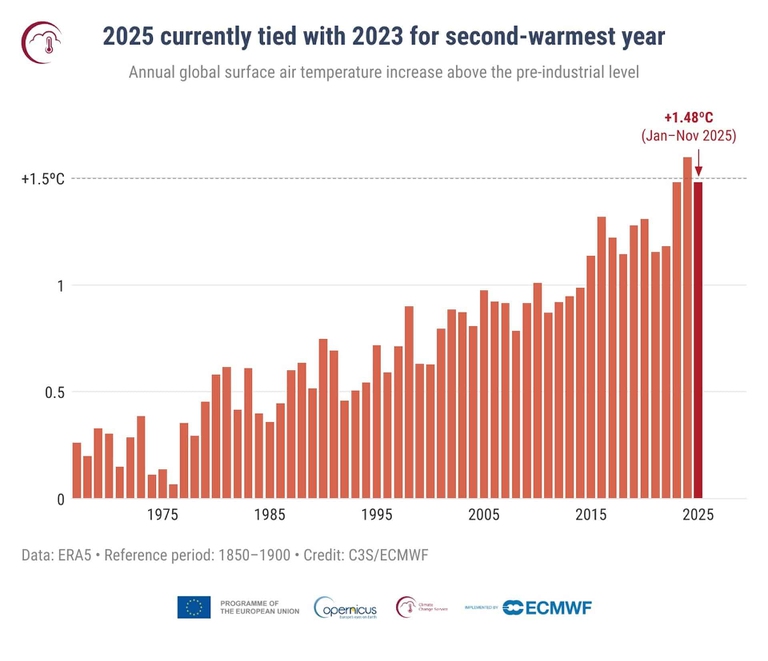
2025 will most likely be the second warmest year ever recorded. The measurements carried out by the European Copernicus monitoring service have become a worrying routine. For years now, through its work, the scientific results has been reminding us how global warming and its effects are already part of our daily lives.
Global average temperature is 1.48 degrees above the pre-industrial level
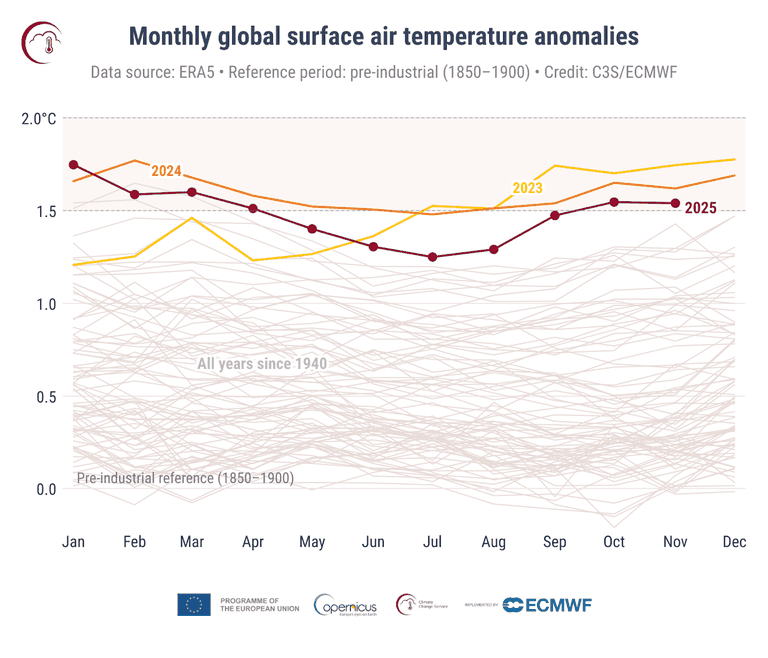
According to a statement released on Tuesday 9 December, the current year could match 2023: “The global average temperature for the period from January to November 2025,” Copernicus explained, “was 0.6 degrees Celsius above the 1991–2020 average, and 1.48 degrees above the pre-industrial period”. That is, before humanity (and especially the wealthiest part of the planet) began burning coal, oil and gas to fuel production.
We are therefore continuing to dangerously brush up against the 1.5 degrees Celsius threshold, the more ambitious target within the 1.5–2 degrees range set by the 2015 Paris Climate Agreement. Of course, to say that global warming has officially reached and exceeded the lower limit of that range, global average temperatures would need to remain stably above 1.5 degrees.
The 2023–2025 period could be the first to exceed 1.5 degrees Celsius overall
But the trend is as clear as it is alarming. If the figures are confirmed, the 2023–2025 period could be the first to have exceeded the threshold overall. The hope is that this will prove to be a temporary overshoot: for that to happen, however, greenhouse gas emissions must be cut immediately and drastically. Above all, this would require abandoning the continued burning of fossil fuels—a solution on which the world appeared deeply divided at the latest United Nations climate conference, Cop30 in Belém.
🌡️The latest #CopernicusEU C3S Climate Bulletin shows Nov 2025 was the 3rd-warmest November on record, at 14.02°C – 0.65°C above the 1991–2020 average (surface air temperature).
Anomalies reveals extreme warmth across the Arctic, with peaks of +5–7°C.
For the definitive data for 2025, it will be necessary to wait for the December figures. It is unlikely that the record for the hottest twelve-month period ever, set in 2024, will be broken, but it is equally unlikely that temperatures will fall far from that historic peak.
In November, numerous extreme weather events and heavy human losses
With all the resulting impacts and consequences in terms of climate crisis. Copernicus itself recalls that just last November was marked by “numerous extreme weather events, particularly tropical cyclones in Southeast Asia, which caused large-scale catastrophic flooding and resulted in serious loss of life”.
November was in fact the third warmest on record, with an average temperature over land and ocean surfaces of 14.02 degrees—0.65 degrees above the 1991–2020 average. In particular, above-average values compared with recent decades were recorded almost everywhere in the world, with peaks in northern Canada, the Arctic Ocean and across Antarctica.
The oil giant TotalEnergies must defend itself against accusations of failing to take into account the climate consequences resulting from the use of its products.
From Australia to the United States, from Chile to Mozambique, and from Russia to Argentina, many countries are grappling with extreme weather conditions.
A Greenpeace report denounces Russia’s political and economic model: a nexus of extractivism, authoritarianism and war that is destroying the environment, with serious repercussions for the global ecosystem.