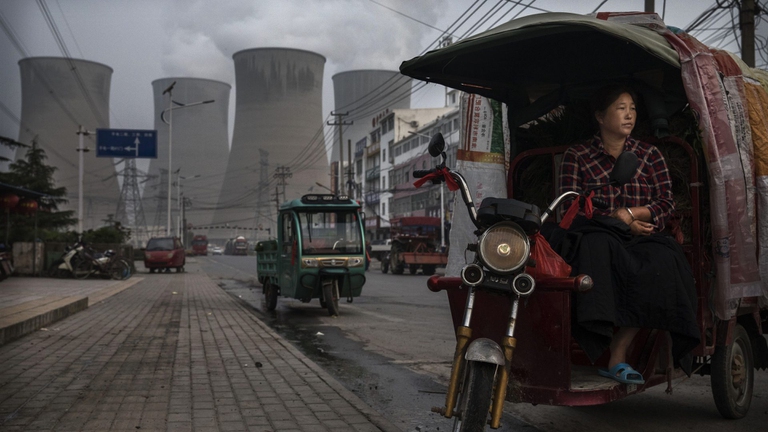
China may soon reach its peak in greenhouse gas emissions. The use of the conditional is necessary, as medium- to long-term data will need to be verified, and it is not currently possible to predict a specific date. However, current trends leave room for optimism. This is according to an analysis by Carbon Brief, which found that China’s total emissions have remained flat or have declined over the past 18 months.
China’s emissions data carry “great symbolic importance”
As early as the first quarter of the current year, China recorded a decline in emissions for the first time, driven by the growth of renewable energy generation. This marked the first time such a decrease occurred independently of electricity demand, which in the same period rose significantly, making the data even more meaningful.
Analysis: China’s CO2 emissions have now been flat or falling for 18 months | @laurimyllyvirta
From an absolute perspective, the decline remains limited and does not significantly affect the planet’s overall emissions trajectory. Its political weight, however, is considerable. “An increase or decrease of less than 1 per cent may not make a major difference in terms of targets, but it carries great symbolic importance,” Carbon Brief notes in its report.
Strong results from transport, cement and steel; chemicals lag behind
Some sectors appear more virtuous than others in China. The transport sector recorded a 5 per cent reduction in emissions in the third quarter of 2025 compared with the same period the previous year, largely due to the spread of electric vehicles. Emissions from steel and cement production remained stable, despite a 6.1 per cent increase in demand, which effectively represents a positive outcome. By contrast, the chemical industry registered a sharp increase in emissions.
Despite these trends, the emissions reduction pledge announced by the Beijing government in September has been widely regarded as disappointing. The commitment refers to a reduction of between 7 and 10 per cent by 2025, without providing further details.
Coal still accounts for 60 per cent of China’s electricity
In absolute terms (though not per capita), China remains the world’s largest emitter of CO₂, responsible for around 30 per cent of global emissions, equivalent to approximately 15.6 billion tonnes of CO₂-equivalent, according to UN data. Historically, however, the United States still ranks first in cumulative emissions.
As for electricity generation, despite the massive expansion of renewables, China still relies on coal for around 60 per cent of its power production—by far the most polluting and climate-damaging energy source. The road toward completing the ecological transition, therefore, remains long.
Pescasseroli, in the heart of Italy’s Apennines, will host the IBA conference on bear conservation and human–bear coexistence. LifeGate will be the event’s media partner.
The toll is still provisional, but data collected across several European countries indicate that tens of thousands of people have died as a result of extreme heat.
Last February, Malaysia imposed a total ban on electronic waste imports. Yet toxic e-waste continues to arrive from the United States and other countries through illegal trafficking networks.
Although Earth Overshoot Day falls six days later than in 2025, this does not represent an improvement. The shift is the result of revised estimates of the oceans’ carbon absorption capacity, while humanity’s actual ecological footprint continues to grow.
Greece has launched a wildfire management system based on nanosatellites and artificial intelligence. A model that other countries are now looking to replicate.
According to analysts, the emergence of a “super” El Niño could trigger a global food price shock, adding to inflationary pressures already fuelled by the conflict with Iran.