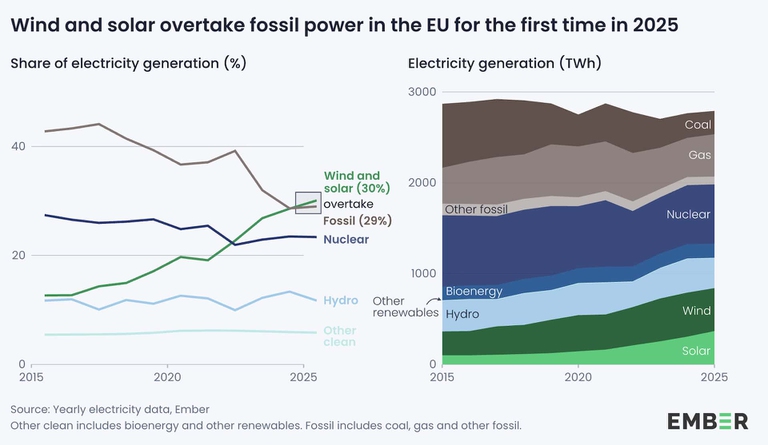
2025 will go down in history as a landmark year for the ecological transition. For the first time, renewables have overtaken fossil fuels in Europe in terms of electricity generation. The milestone is confirmed by the European Electricity Review 2026, published on 22 January by the think tank Ember.
Renewables at 30 per cent of Europe’s power generation, fossil fuels at 29 per cent
The report explains that, when hydropower and other clean energy sources are also taken into account, renewables as a whole covered 48 per cent of electricity generation across Europe. In particular, solar photovoltaics and wind power accounted for 30 per cent, overtaking coal, oil and gas, which together stood at 29 per cent. Less than a quarter of European electricity generation (23 per cent) came from nuclear power, which—unlike renewables, which continue to grow—has remained broadly stable.
2025 was another RECORD-breaking year for the EU energy transition.
🇪🇺 Wind and solar overtook fossil fuels in the EU electricity mix 🇪🇺 Wind and solar surpassed fossils in 14 of 27 EU countries’ electricity mix 🇪🇺 Solar grew by a record 20% last yearhttps://t.co/Xc3t0VEw14pic.twitter.com/NgVMjokJVD
The positive trend is further highlighted by the continued decline of fossil fuels, which now appears irreversible. The most harmful energy sources in terms of greenhouse gas emissions were overtaken by renewables in 14 of the EU’s 27 member states: Sweden, Denmark, Luxembourg, Lithuania, Finland, Spain, Austria, France, Belgium, Hungary, Germany, Croatia and the Netherlands. Italy does not feature on the list, where the gap between renewables and fossil fuels remains wide, albeit slowly narrowing.
Solar power up by more than 20 per cent compared with 2024
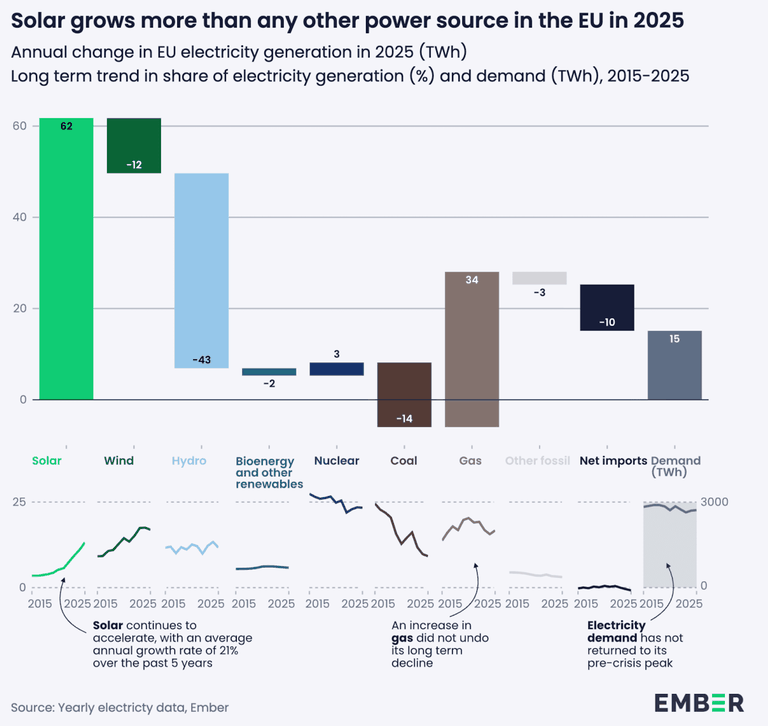
The strongest growth in Europe has been in solar power. The now very low cost of installations has facilitated the adoption of this renewable source, which also benefited from favourable weather conditions—unlike hydropower, which was affected by low rainfall. As a result, photovoltaic plants generated 369 terawatt-hours of electricity in 2025, an increase of more than 20 per cent compared with the previous year.
Solar power growth in Europe @ Ember
According to Ember, this marks the fourth consecutive year in which solar power has grown by more than 20 per cent. In June, solar became the largest electricity source in Europe for the first time. Hydropower generation, by contrast, fell by 12 per cent, while wind power grew by a more modest 2.5 per cent. Less windy conditions prevented wind energy from maintaining its 2024 output, despite an additional 5.3 gigawatts of installed capacity.
Coal continues to decline, but Europe remains heavily dependent on gas
As for fossil fuels, the most positive news concerns the continued decline of coal, by far the most damaging energy source in terms of climate change, which now accounts for no more than 10 per cent of total electricity generation in the EU. Nineteen European countries have almost completely phased it out of their energy mix. Only Germany and Poland still rely on it to a significant extent.
Wind and solar power overtake fossil fuels in Europe @ Ember
The situation regarding gas is less encouraging. The European Union remains heavily dependent on it, with gas-fired power plants generating 466 terawatt-hours of electricity in 2025, an increase of 8 per cent. According to Ember’s report, however, this rise is linked to the decline in hydropower. In previous years, gas use had also fallen, largely due to higher prices following Russia’s invasion of Ukraine.
You have time until 7 November to enroll. ClimAlt online lessons are completely free and are aimed at young people living in the European Union who care about climate change.
Scientists from Harvard University in the United States are launching the biggest solar geoengineering programme to date, with a view to study the effects of this technology as a potential fix for global warming. The project due to take off in a few weeks consists of spraying sulphate aerosols about 20 kilometres in height into the Earth’s stratosphere.
By Anne Hidalgo, Mayor of Paris Clover Moore, Lord Mayor of Sydney Yuriko Koike, Governor of Tokyo Patricia de Lille, Mayor of Cape Town The next four years will be crucial in determining if the world can avoid the worst impacts of climate change, keeping the global temperature rise to below 1.5 degrees. As the
They’ve met at the Trump Tower the same day the US president-elect nominated climate change denier Scott Pruit to lead the Environmental Protection Agency (EPA). Leonardo DiCaprio, accompanied by Terry Tamminen – CEO of the Leonardo DiCaprio Foundation, has handed to Donald Trump a detailed framework on the huge economic potentiality of investing in clean
Energy in India: an overview India is a country of over 1 billion people, around 18% of the world population. 60% of Indians live in rural areas and at least 240 million have no access to electricity. It is one of the fastest growing economies in the world, estimated to grow 8% in the next
The history of energy in Brazil: “the oil is ours” Brazil drilled its first oil well in 1897 in Bofete City and in 1953 the oil and gas giant Petrobras was founded under the slogan “o petróleo é nosso” (the oil is ours). Over the years, Brazil diversified its energy matrix. Starting from the 1940s
A history Significant changes in the history of energy in the United States have mainly been dictated by the development of new resources. From the use of wood up to the late 1800s to early industrial growth powered by water mills, coal became the first source of primary energy in the late 19th century. In