


A report by the NGO network Climate Action Network proposes a series of concrete changes to revitalise the UN Climate Change Conferences.
Un milione di firme per spingere Bruxelles a vietare il glifosato in Europa. Questa volta non si tratta della solita petizione online.
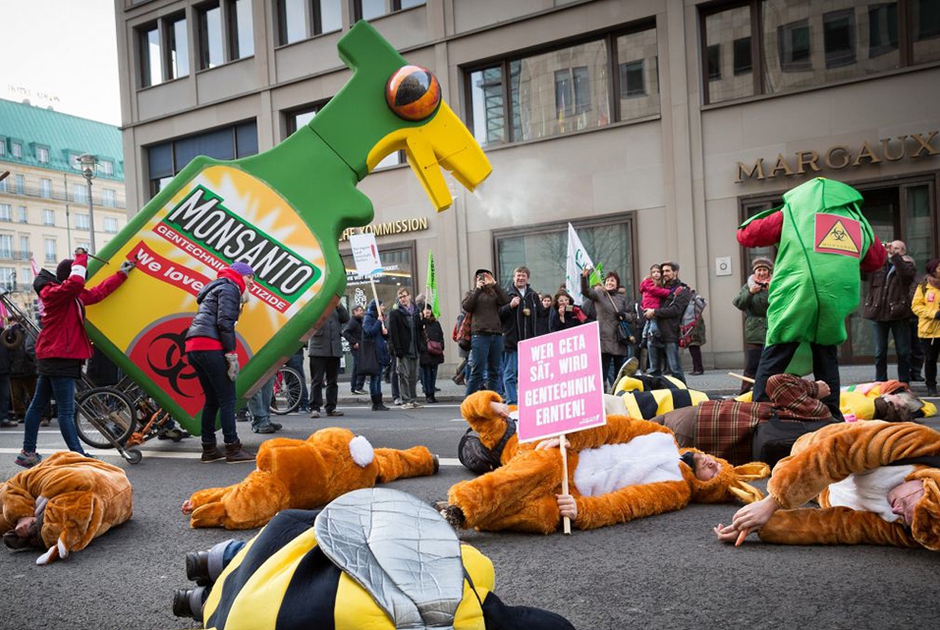
This isn’t a petition like any other. It’s an official collection of signatures aimed at urging the European Commission to propose a European ban on glyphosate. For the petition to be effective, the European Citizens Initiative (ECI) needs to be signed by at least 1 million citizens (out of a total of 510 million) residing in at least 7 of the 28 countries making up the European Union (EU), within a year.
Sign the initiative to say #StopGlyphosate
Glyphosate is currently the most widely used herbicide in agriculture. It is the active ingredient of the Roundup weed killer, whose patent was owned by Monsanto until 2001. Normally, it is associated with cultivations – like soy – modified genetically to resist big doses of the herbicide. A report by the International Agency for Research on Cancer (IARC), which is part of the United Nations’ World Health Organisation, published in the journal The Lancet Oncology, defined glyphosate as “likely carcinogenic” to humans. Instead, the European Food Safety Authority (EFSA) says that it’s “not likely to be carcinogenic to humans” – but was accused of having based its assessment on a German study financed by companies producing herbicides.
The initiative to ask a total European ban on glyphosate started on the 8th of February and is promoted by a coalition of associations committed to protecting the environment and health across 15 countries, including #StopGlifosato, Greenpeace, WeMove, Pesticide Action Network, the Health and Environment Alliance and Corporate Europe Observatory.
In June 2016 the European Commission had to tackle the fact that the 28 member countries hadn’t taken a decision on the herbicide’s authorisation, also due to public opinion calling strongly for its ban. So, it decided unilaterally to renew the authorisation for glyphosate’s use for a further 18 months, until 2017. This means that it’s imperative the European Citizens Initiative reach its goal by the summer.
“This year we have the opportunity of banning glyphosate from our fields and our food. Evermore water courses in Italy and all over Europe are contaminated by this herbicide, classified as probably carcinogenic by IARC. Traces of glyphosate have been found in food, beverages and human urine. The message to the Commission is clear: people’s interests and health should come before agrochemical companies’ profit,” said Federica Ferrario, head of Greenpeace Italia’s sustainable agriculture campaign.
The text underlying the ECI also denounces the lack of transparency in European procedures for approving pesticides. Thus, it urges a reform of approval procedures through the definition of binding reduction objectives on glyphosate use in the EU. The fight to ban glyphosate, therefore, needs to be viewed as part of broader framework aimed at achieving a new model of sustainable agriculture.
Sign the initiative to say #StopGlyphosate at www.stopglyphosate.org
Siamo anche su WhatsApp. Segui il canale ufficiale LifeGate per restare aggiornata, aggiornato sulle ultime notizie e sulle nostre attività.

Quest'opera è distribuita con Licenza Creative Commons Attribuzione - Non commerciale - Non opere derivate 4.0 Internazionale.
A report by the NGO network Climate Action Network proposes a series of concrete changes to revitalise the UN Climate Change Conferences.
Pescasseroli, in the heart of Italy’s Apennines, will host the IBA conference on bear conservation and human–bear coexistence. LifeGate will be the event’s media partner.
Il glifosato è stato autorizzato per altri cinque anni in Europa. I paesi hanno raggiunto la maggioranza qualificata grazie (o a causa del) al cambio di rotta della Germania.
The inflation caused by extreme weather events is known as “climateflation”: prices for many food products are expected to rise sharply.
The toll is still provisional, but data collected across several European countries indicate that tens of thousands of people have died as a result of extreme heat.
Last February, Malaysia imposed a total ban on electronic waste imports. Yet toxic e-waste continues to arrive from the United States and other countries through illegal trafficking networks.
Although Earth Overshoot Day falls six days later than in 2025, this does not represent an improvement. The shift is the result of revised estimates of the oceans’ carbon absorption capacity, while humanity’s actual ecological footprint continues to grow.
Gigantic wildfires in France’s Gironde region and near Madrid, Spain, have devastated tens of thousands of hectares of vegetation.
Greece has launched a wildfire management system based on nanosatellites and artificial intelligence. A model that other countries are now looking to replicate.