The new report by Italian intelligence services also focuses on climate change and its impacts on migration and domestic security.
Charts describing the rise in average temperatures, future emission scenarios and projections of climate change by 2100. This is not a new report by the Ipcc, the Intergovernmental Panel on Climate Change, but the annual report of Italian intelligence services. This year it dedicates a small but significant section — among the most pressing global and domestic threats — to climate change, alongside domestic and religious terrorism, hybrid warfare and disinformation.
Why the intelligence report also discusses climate
According to the report by Dis, Aisi and Aise (Italy’s Department of Information for Security, the domestic intelligence agency and the foreign intelligence agency), climate change is not only an environmental issue. It also acts as a multiplier of instability, particularly because it generates migration flows, which — from an intelligence perspective — also represent a security issue for governments.
This causal chain has now become solid enough to appear in an intelligence document. In the chapter dedicated to the evolution of migration, the report explains that climate change is gaining “increasing importance.” Floods and droughts, it says, are “no longer exceptional events but recurring realities,” encouraging migration as a form of family adaptation. In the past, people often migrated after suffering a catastrophic event — losing their land, crops, homes or jobs. Today migration is increasingly preventive and planned, because communities know that sooner or later disaster will arrive.
Bangladesh, is explicitly cited in the report among the countries generating migration flows that are “more predictable and constant, but also harder to stop through deterrence measures.” The same pattern is seen in Pakistan, Sudan, Somalia and Yemen, where economic crises and conflicts overlap with severe droughts, declining agricultural productivity and collapsing essential services. Intelligence analysts describe these situations as “hybrid crises” — not purely wars and not purely natural disasters, but a combination of both. In 2026, they are expected to represent a significant share of migration flows affecting Italy and Europe.
Temperature, oceans and emissions
![]()
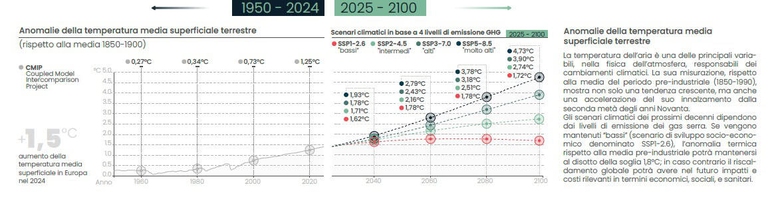
The analysis is accompanied by charts reminiscent of those produced by the Ipcc. The first chart shows the trend in global temperatures. Italian intelligence notes that in 2024 the average surface temperature in Europe recorded an anomaly of +1.5°C compared with pre-industrial levels (1850–1900).
The historical graph shows a curve rising slowly until the 1990s and then accelerating clearly. Future scenarios depend on how many emissions humanity produces.
-
In the best-case scenario (low emissions), the temperature anomaly would reach +1.62°C by the end of the century.
-
In the worst-case scenario (very high emissions), it could reach +4.73°C.
![]()
The second chart focuses on ocean temperatures. In 2024 the Mediterranean Sea recorded a +1.2°C anomaly compared with the 1982–2015 average. Warmer oceans mean more energy available for extreme weather events and rising sea levels. The report makes this explicit: without mitigation measures, the oceans will become “increasingly vast reservoirs of energy,” with direct consequences for storm frequency and coastal geography.
![]()
The third chart concerns European emissions, and the picture here is somewhat positive. The European Green Deal has produced tangible results, and in 2024 Europe accounted for just 5.9 per cent of global emissions. However, the problem lies precisely in Europe’s relative insignificance within the global emissions landscape, which continues to grow. Without additional containment measures, global emissions could exceed 67 billion tonnes by 2050.
The real news, however, is that intelligence agencies are now concerned about climate change. This reflects a reality in which the boundaries between environmental, economic and political security have already blurred. When climate-driven drought destroys crops in Sudan, pushing hundreds of thousands of people toward Libya and then toward Lampedusa, climate change becomes a security issue.
The report estimates that the most likely scenario for 2026 is “stable but substantial migration flows,” with “constant pressure likely to persist over time.” Not a sudden emergency, but a structural condition — much like the current state of climate change itself.
Siamo anche su WhatsApp.
Segui il canale ufficiale LifeGate per restare aggiornata, aggiornato sulle ultime notizie e sulle nostre attività.

Quest'opera è distribuita con Licenza Creative Commons Attribuzione - Non commerciale - Non opere derivate 4.0 Internazionale.