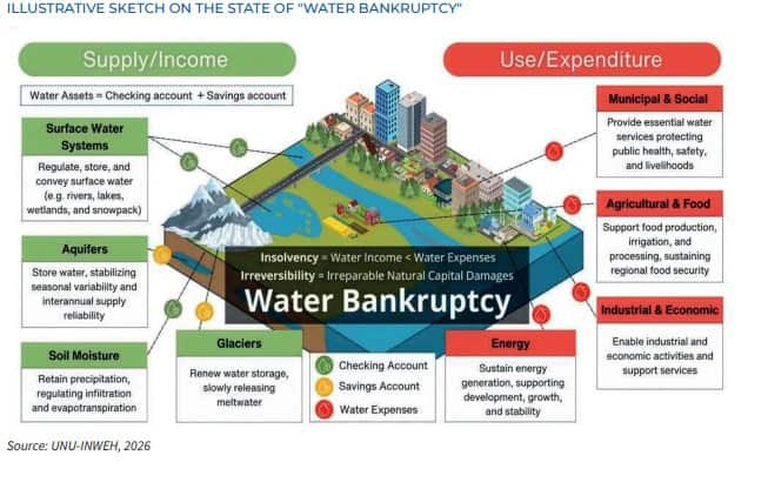
The world is in “water bankruptcy,” and the Blue Book 2026 paints a picture of a country that wastes nearly four out of ten litres, where inequalities prevail.
Forget rising gas and oil prices, forget the risk of an economic crisis: rather, the world is approaching water bankruptcy. For this reason, World Water Day, celebrated on March 22, must be a real opportunity for reflection and discussion. The term “water bankruptcy” is used in the Blue Book 2026, the annual report on Italy’s integrated water service produced by Utilitalia and the Utilitatis Foundation, which cites data, warnings and a definition from the United Nations University: it means that the planet has exceeded the point at which water demand can be met by renewable availability.This is no longer a temporary crisis that we can overcome whenever we choose: the dynamics already underway — depletion of aquifers, retreat of glaciers, alteration of the hydrological cycle — are largely irreversible on a human timescale. And this is where Italy comes into play, given that the Mediterranean is among the areas of the planet most exposed to the effects of the climate crisis.
Water bankruptcy starts with waste
The most immediate and hardest-to-accept figure is that of network losses: in Italy, 37.9 per cent of the water fed into pipes does not reach its destination. It is lost along ageing, patched-up networks, often poorly mapped. In linear terms, this means 24 cubic metres lost per kilometre of network every day. This is not entirely new, as it is broadly in line with recent years. But the real news is precisely that, despite the drought plan and PNRR funds, no decisive action has yet been taken.
The Blue Book 2026 analyses a sample of more than 324,000 kilometres of pipelines: 30 per cent are over thirty years old, and more than 40,000 kilometres are over fifty years old. These are infrastructures that in many cases date back to the post-war period and have never been systematically replaced. And the waste is not only water: in 2024, more than 16 per cent of the electricity consumed by the water sector was used to pump water that was never actually consumed. The paradox is that the technology to reduce these losses already exists. Sensors, network districting, satellite monitoring of reservoirs: tools already operational in many Italian contexts. And yet only 38 per cent of networks are organised into districts that allow real-time detection and localisation of leaks.
The South pays twice
If losses are a national problem, their geographical distribution tells another familiar story, marked by inequalities across all Italian infrastructure sectors. Linear losses range from 17 cubic metres per kilometre per day in north-western Italy to 41 in the South. But this is not only a matter of pipes: in the South, 66 per cent of municipalities still rely on direct management, the so-called “in-house” systems, often lacking the resources and expertise to invest.
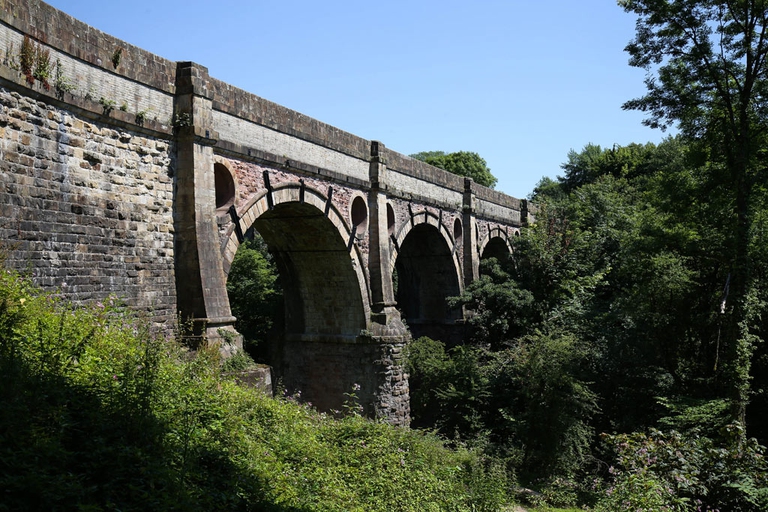
Vecchi e poco efficienti, gli acquedotti italiani generano sprechi di acqua
These fragmented systems invest on average just 22 euros per inhabitant per year, compared with 90 euros for industrial operators. The result is infrastructure that is not renewed, that loses more, and that delivers less. The Blue Book also records strong territorial disparities even in the number of hours of water supply guaranteed. In the North and Centre-South macro-areas, even well into the 21st century, access to drinking water — a human right recognised by the UN since 2010 — is still not equal for all Italian citizens.
PFAS and agriculture
There is another striking figure that says a lot about the country’s priorities: the rate of reuse of treated wastewater. The estimated technical potential is 13.4 per cent. The actual figure is 3.4 per cent. Less than a quarter of what is possible. In a Mediterranean country, thirsty in summer and flooded in winter, wasting already treated water — which could be reused in agriculture, industry and urban irrigation — is a significant choice. Italian agriculture, among the most productive in Europe, especially in water-intensive crops such as fruit and vegetables, depends structurally on water. Yet the reuse supply chain struggles to take off due to regulatory, infrastructural and cultural reasons.
The report also highlights the presence of new contaminants in drinking water: PFAS, known as “forever chemicals”, microplastics and cyanotoxins. Italy has transposed the new European directive by introducing stricter limits than those required: from 2026, a limit of 0.02 micrograms per litre will apply to the sum of the four PFAS with the highest bioaccumulation potential. This is good news, but it requires investment in monitoring and treatment that not all local realities are able to sustain.
Teha, la crisi idrica in Italia costa 13 miliardi l'anno. Libro bianco: 227 euro a testa, il doppio della media europea #ANSAhttps://t.co/10XOWexDR0
A fifth of GDP — but it doesn’t make the headlines
Up to this point: sustainability, life, human rights. But for more pragmatic readers, it is striking that without water, according to the Blue Book 2026, 20 per cent of Italy’s GDP could not be generated, equal to 384 billion euros.
In the Mediterranean basin, the broader water sector is worth 1,902 billion dollars, 15 per cent of the entire region’s GDP. Technology can at least help in some cases: thanks to the integration of optical and radar satellites, it is now possible to monitor reservoir levels in near real time and under any weather conditions, to quickly identify situations of water scarcity and intervene through storage systems. Because if it is true that water must not be wasted, it is also true that today it is possible — and necessary — to retain and store it when available. As Barbara Marinali, deputy vice president of Utilitalia, points out, “water cannot be replaced: it is the only irreplaceable factor of production, unlike other energy resources.”
And yet it is still talked about far too little: water, writes the Blue Book 2026, is “at once the foundation of life, an indicator of social justice, and a pillar of ecological sustainability.”
Pescasseroli, in the heart of Italy’s Apennines, will host the IBA conference on bear conservation and human–bear coexistence. LifeGate will be the event’s media partner.
The toll is still provisional, but data collected across several European countries indicate that tens of thousands of people have died as a result of extreme heat.
Last February, Malaysia imposed a total ban on electronic waste imports. Yet toxic e-waste continues to arrive from the United States and other countries through illegal trafficking networks.
Although Earth Overshoot Day falls six days later than in 2025, this does not represent an improvement. The shift is the result of revised estimates of the oceans’ carbon absorption capacity, while humanity’s actual ecological footprint continues to grow.
Greece has launched a wildfire management system based on nanosatellites and artificial intelligence. A model that other countries are now looking to replicate.
According to analysts, the emergence of a “super” El Niño could trigger a global food price shock, adding to inflationary pressures already fuelled by the conflict with Iran.