The latest State of the Climate in Europe report paints an alarming picture: the climate crisis is hitting the continent harder than the rest of the world.
Europe continues to confirm itself as a “hot spot” of the climate crisis — one of the macro-regions where global warming is manifesting itself most violently. Temperatures on the continent are rising twice as fast as the global average. This is according to the latest edition of the State of the Climate in Europe report, produced by the European Centre for Medium-Range Weather Forecasts (ECMWF) in collaboration with the World Meteorological Organization (WMO) and the European Copernicus service.
Extreme heat in Europe: temperatures above 30°C even inside the Arctic Circle in 2025
According to the report, in 2025 “Europe was exposed to increasingly severe impacts — from record-breaking marine and land heatwaves to devastating wildfires and continuing biodiversity loss — with consequences for societies and ecosystems alike.” The findings are based on analyses conducted by around one hundred scientists who contributed to the report, providing a comprehensive picture of the climate situation.
🌍🔥 Europe is heating up — but not evenly.
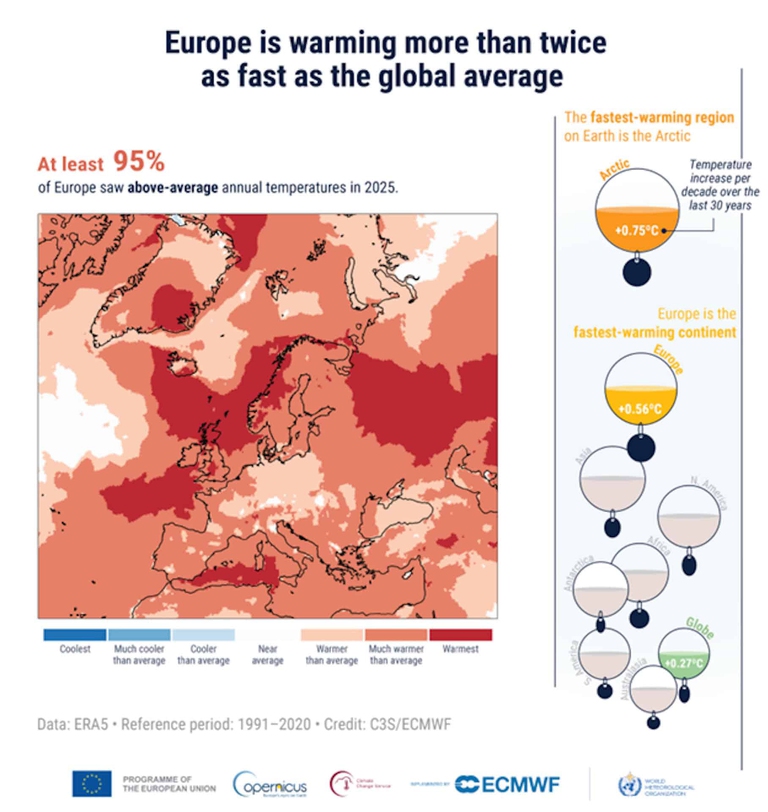
This map from The European State of the Climate 2025 report shows how the rate of warming varies across the continent, with eastern and northern Europe warming faster than many other regions over the past three decades. pic.twitter.com/2HCqRNyA4i
— EU EnvironmentAgency (@EUEnvironment) May 3, 2026
“Europe is warming faster, and the consequences are already severe,” commented Florian Pappenberger, Director General of ECMWF. “Almost the entire region recorded annual temperatures above average. Norway, Sweden and Finland experienced their worst heatwaves ever, with twenty-one consecutive days of temperatures exceeding 30 degrees Celsius even within the Arctic Circle.”
Greenland lost 139 billion tonnes of ice
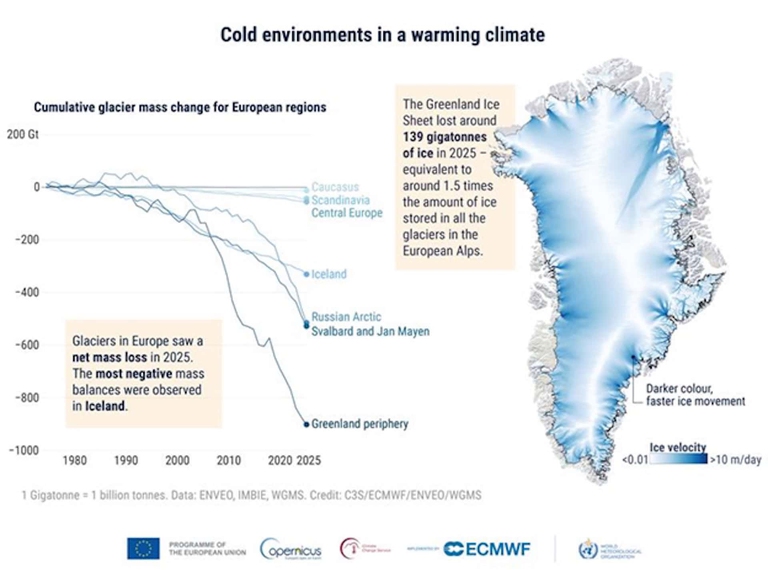
According to the report, at least 95 per cent of European territory recorded above-average annual temperatures during 2025. As a result, glaciers across all regions experienced a net loss in mass, with Iceland recording its second-largest decline since measurements began. Meanwhile, the Greenland ice sheet lost an astonishing 139 billion tonnes of ice. At the same time, snow cover in mountainous areas was 31 per cent below average.
One million hectares of forest destroyed by megafires
Marine heatwaves were also extremely widespread, affecting 86 per cent of Europe’s oceanic region. In 36 per cent of cases, the events were classified as “severe” or “extreme” — the highest share ever recorded.
Europe is heating twice as fast as the global average.
In 2025, 95% of the continent saw above-average temperatures, alongside record Arctic heat and wildfires burning over one million hectares.
All indicators are therefore in the red. But the consequences of a changing climate are not limited to remote regions. Wildfires burned more than one million hectares of forest last year — the highest figure ever recorded. Meanwhile, heat and lack of rainfall meant that river water levels remained below average across Europe for eleven months out of twelve. Extreme weather events were also frequent, with storms and floods affecting thousands of people across the continent.
Renewables are growing, “but immediate science-based climate action is needed”
Some encouraging news comes from renewable energy, which supplied nearly half — 46.4 per cent — of Europe’s electricity in 2025. Solar energy in particular reached a record 12.5 per cent, continuing its now well-established growth. Biodiversity loss, however, appears unstoppable: according to the report, global warming is one of its main drivers.
Europe is warming >2x as fast as the global average, reducing snow & ice cover. High air temperatures, drought, heatwaves & record ocean temperatures affect regions from the Arctic to the Mediterranean.
— World Meteorological Organization (@WMO) April 29, 2026
“The pace of climate change requires urgent action,” said Samantha Burgess, Strategic Lead for Climate at ECMWF. “With rising temperatures, increasingly widespread wildfires and droughts, the evidence is unequivocal: the climate crisis is not a future threat. It is our current reality. To respond to biodiversity loss, we must adapt as quickly as possible through the transition to clean energy and by grounding political decisions in scientific data.”
The toll is still provisional, but data collected across several European countries indicate that tens of thousands of people have died as a result of extreme heat.