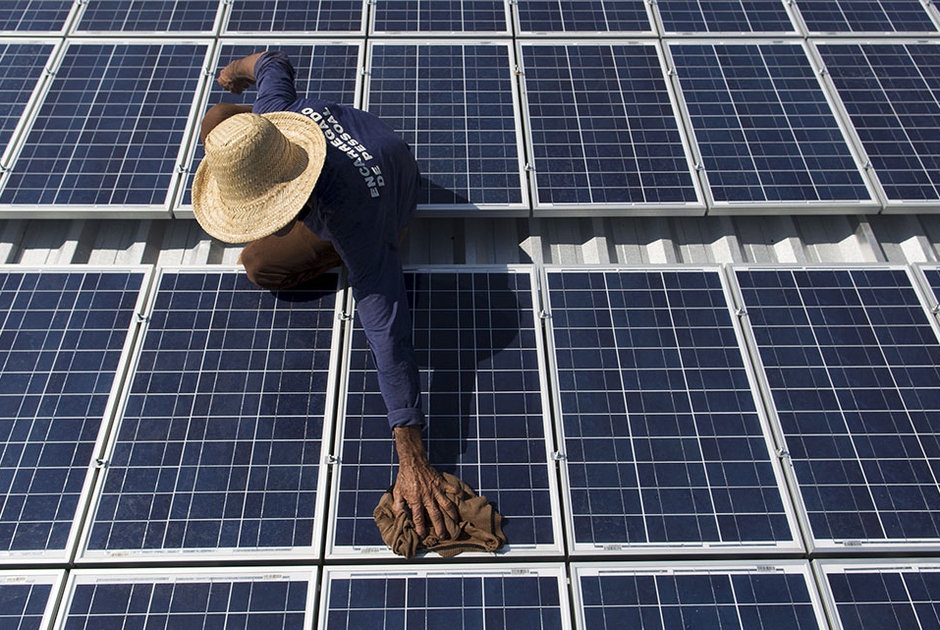
If the entire world followed the recent example of the poorest and most vulnerable countries facing the impacts of climate change, we would probably be in a less dramatic situation — at least when it comes to the development of renewable energy. This is explained by a study published by the British think tank Ember, which highlighted the “extraordinary” progress achieved by 74 member states of the Climate Vulnerable Forum, an organization of countries most affected by the climate crisis.
"For the first time, developing countries can build a cheaper, more reliable energy path to prosperity on their own terms," says report author Daan Walter.
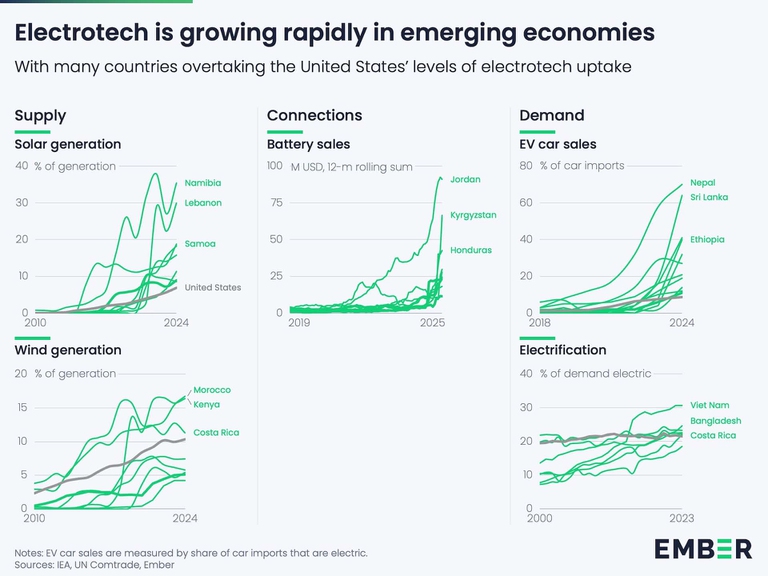
Solar power: one third of Climate Vulnerable Forum countries have surpassed the United States
These countries — located in Africa, Asia, South America and the Pacific — account for just 3.9 per cent of global Gdp, despite being home to 1.7 billion people (around 500 million of whom still lack access to electricity). For them, the development of renewables represents an opportunity to break free from conditions that are often marked by serious economic and social underdevelopment.
According to Ember’s report, one third of these states has already surpassed the United States in terms of the share of electricity generated from solar power within their national energy mixes. Around ten of them also outperform the US in terms of the share in final energy consumption (which stands at 20 per cent in the United States). These figures may even be underestimated, as statistics are often incomplete, and 80 per cent of the forum’s member states have imported at least three times more solar panels since 2017 than their officially installed capacity suggests.
“In recent years, we have witnessed something almost miraculous”
In Namibia, for example, the share of electricity generated from solar power increased from 6 per cent to 35 per cent between 2017 and 2024. In Morocco, wind energy has doubled since 2018. In Ethiopia, the share of electric vehicles in the car fleet rose from 1 per cent to 6 per cent. Similarly, in Vietnam, 250,000 electric bikes and scooters were sold in 2024 alone.
“Over the past two to three years, we have witnessed something almost miraculous,” said Daan Walter, director at Ember. “The world’s poorest nations, often portrayed as lagging behind in the energy transition, have made huge strides.”
The key factor: the dramatic drop in renewable energy costs
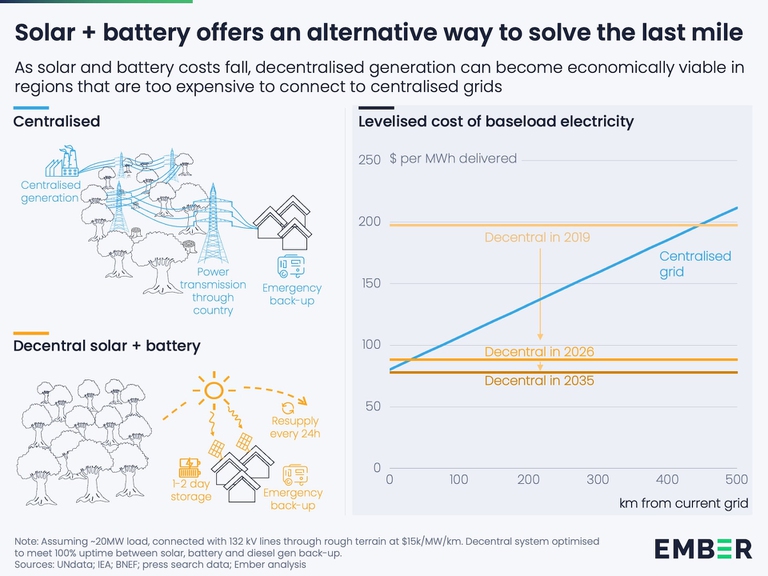
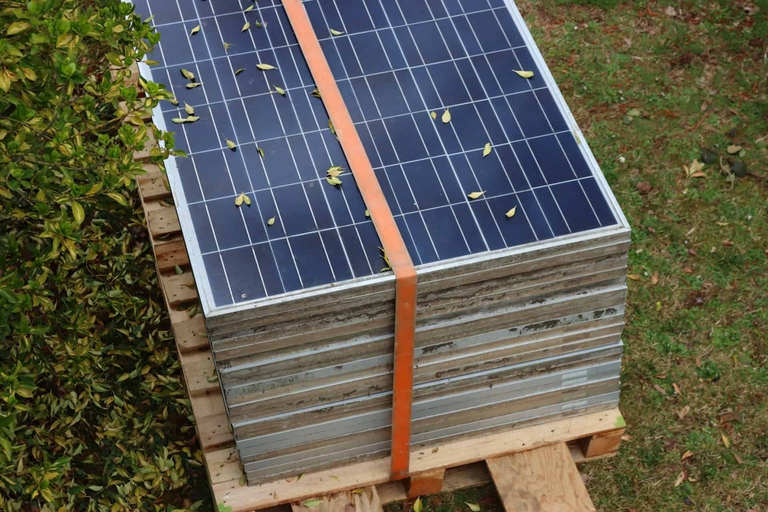
What has enabled less developed countries to benefit from renewable energy is above all one factor: the dramatic drop in costs in recent years. Combined with the ease of installing especially small-scale systems, this has allowed clean energy sources to spread rapidly.
Even for larger infrastructure, Ember points out that investments required for a solar farm are now lower than those needed for coal or gas plants. “For emerging economies, this is the key element,” Walter adds. “We are living through a crucial moment. Countries with limited resources are no longer forced to choose fossil fuels.” This also means freeing themselves from a heavy financial dependence.
Il processo di elettrificazione nei paesi del Climate vulnerable forum @ Ember
The process of electrification and energy efficiency is benefiting from the same trend: the report highlights that over the past fifteen years, prices have also dropped significantly for LED light bulbs, air conditioners, refrigerators and electric cooktops — with reductions ranging from 27 to 95 per cent.
By Anne Hidalgo, Mayor of Paris Clover Moore, Lord Mayor of Sydney Yuriko Koike, Governor of Tokyo Patricia de Lille, Mayor of Cape Town The next four years will be crucial in determining if the world can avoid the worst impacts of climate change, keeping the global temperature rise to below 1.5 degrees. As the
Energy in India: an overview India is a country of over 1 billion people, around 18% of the world population. 60% of Indians live in rural areas and at least 240 million have no access to electricity. It is one of the fastest growing economies in the world, estimated to grow 8% in the next
The history of energy in Brazil: “the oil is ours” Brazil drilled its first oil well in 1897 in Bofete City and in 1953 the oil and gas giant Petrobras was founded under the slogan “o petróleo é nosso” (the oil is ours). Over the years, Brazil diversified its energy matrix. Starting from the 1940s
Pescasseroli, in the heart of Italy’s Apennines, will host the IBA conference on bear conservation and human–bear coexistence. LifeGate will be the event’s media partner.
A history Significant changes in the history of energy in the United States have mainly been dictated by the development of new resources. From the use of wood up to the late 1800s to early industrial growth powered by water mills, coal became the first source of primary energy in the late 19th century. In
The Rockefeller family fund confirms it will give up fossil fuels. “It makes little sense—financially or ethically—to continue holding investments in these companies”.
A poco meno di un mese dalla Cop21, le isole si candidano a diventare laboratorio per le rinnovabili, in prima linea per contrastare i cambiamenti climatici.
Enough with coal, oil and natural gas. From now on Hawaii will only build plants that generate electricity using renewable sources and will cut all funding for fossil fuels. The aim: to be powered by 100% renewables by 2045. The announcement was made by state governor David Ige, electrical engineer, at the Asia Pacific Resilience