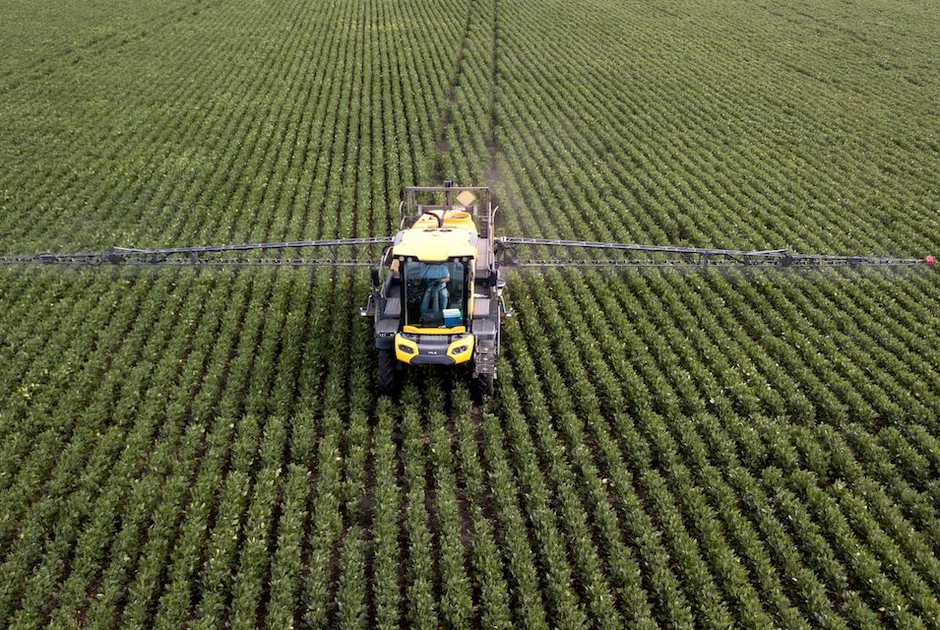
Searching on specialized websites, picloram is described as a systemic herbicide used against broadleaf weeds, shrubs and woody plants. It is a pesticide considered particularly effective in pastures, forest areas, along roads and railways, as well as on industrial land. Its use is widespread, although among the general public its name is certainly less well known than other substances that have attracted far more controversy in recent years, such as glyphosate.
Picloram has never been classified as carcinogenic
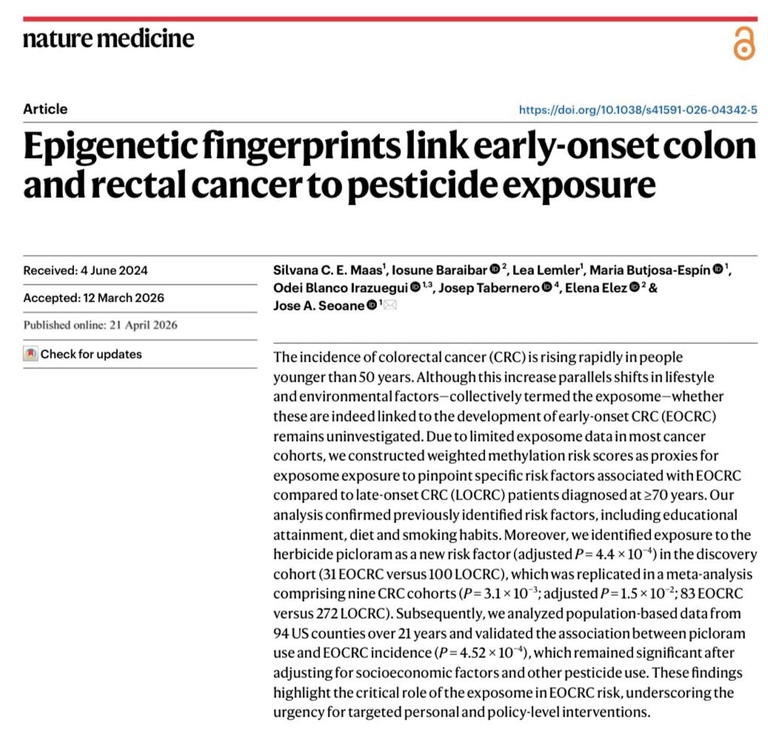
Picloram’s relative lack of notoriety is mainly due to one factor: until now, it has never been classified as carcinogenic. Until now, precisely because a study published in the scientific journal Nature Medicine has linked exposure to the substance with the sharp increase in colorectal cancers recorded among people under the age of 50.
An analysis of #exposome traits in patients with early onset #CRC (<50 yrs) compared with late-onset CRC (≥70 yrs) based on epigenetic markers shows that pesticide usage, in particular picloram, is associated with early onset #colon and #rectal#cancer.https://t.co/1J92E94DfL
The research was conducted by José A. Seoane of the Vall d’Hebron Institute of Oncology in Barcelona, Spain. Together with colleagues who co-authored the analysis, he relied on large-scale epidemiological data and molecular biology analyses to answer a question that medicine has so far struggled to explain: while colorectal cancer rates are declining among older people, cases are steadily increasing among the under-50s.
“We first tried to compare tumors collected from people below that age threshold and from individuals over 70,” Seoane explained to the French newspaper Le Monde. The aim was to identify what are known as “epigenetic signatures” — molecular traces left on tissues — and determine which exposures may have generated the diseases.
Spanish researchers searching for “epigenetic signatures”
To do so, the researchers carried out extensive data collection work, drawing from previous studies, each focused on a possible cause of disease: from air pollution and obesity to smoking, lifestyles, alcohol consumption and, indeed, several pesticides.
By cross-referencing statistical data with epigenetic signatures, the researchers realized that markers of exposure to picloram were overrepresented among patients affected by early-onset cancers. But that was not all. To further strengthen their hypothesis, they also analyzed pesticide use in 94 US counties between 1992 and 2012, comparing those figures with local cancer incidence data. The result was the same: exposure to picloram appeared correlated with cancer onset — even more so than glyphosate or atrazine.
Why the study could overturn current assessment methods
Another reason why picloram was linked to colorectal cancer in people under 50 is that the pesticide was authorized in the 1960s. This means that today’s under-50 patients may have been exposed to it through food since childhood.
The study on the pesticide picloram published in the journal Nature
But the study’s main innovation lies in the fact that researchers did not stop at statistical analysis. Instead, they explored the mechanisms through which the substance may increase disease risk. Until now, regulatory agencies authorizing pesticides for commercial use have mainly focused on whether such substances can induce changes in cellular DNA. The Spanish analysis instead shows that some substances may “activate” certain genes without directly altering DNA itself, making individuals more predisposed to developing tumors. This finding could therefore call into question the very foundations of the methods currently used to determine whether substances contained in pesticides are dangerous to human health.
Leydy Pech, winner of the 2020 Goldman Environmental Prize for North America, is the beekeeper who defended Mexican Maya land against the agro-industry.
Maude Barlow, Right Livelihood Award recipient for the recognition of water as a human right, tells us about what she defines a global water crisis and the risky yet relatively unknown connection between water protection and commercial agreements.
Monsanto is now property of Bayer, and its name has ceased to exist. Agriculture is in the hands of a few large corporations now more than ever, with dire consequences for people and the environment.
Due to a prolonged drought in Zambia, maize production could fall from the current 3.6 million tonnes to 1.8-2 million tonnes this crop season if the current dry spell which the nation is experiencing continues.
Cuba’s example shows that sustainable development isn’t only possible, it’s necessary. This country was forced to abandon its sugar monoculture and has survived thanks to organic agriculture.
Il glifosato è stato autorizzato per altri cinque anni in Europa. I paesi hanno raggiunto la maggioranza qualificata grazie (o a causa del) al cambio di rotta della Germania.
El Costo Humano de los Agrótoxicos (The Human Cost of Agrotoxins) is Pablo Ernesto Piovano’s photo feature dedicated to breaking the silence on the consequences of a growing use of pesticides. Piovano, an Argentinian photographer, has travelled across his country to document the effects pesticides have on people, the result of which is a series of powerful pictures. Now his work has