Today, the first Conference on energy transition and the phase-out of fossil fuels opens in Santa Marta, Colombia. It is an unprecedented summit, attended — until April 29 — by only 54 of the roughly 200 countries that usually send delegations to United Nations climate conferences (COPs). It is being organized in response to yet another failure of UN summits, most recently the one held in Belém, Brazil.
The Santa Marta Conference: a more political than practical attempt to “shake” the world
The Santa Marta initiative — co-organized by the Netherlands — is more political than practical: not all, but many of the states attending are already convinced of the need to phase out coal, oil and gas in order to limit the dangerous rise in global average temperatures. Moreover, none of the world’s largest greenhouse gas emitters — the United States, China and India — are present in Colombia. Based on the data, therefore, no real solution to climate change can come from this Caribbean coastal city.
Rather, the aim is to try to “shake” the world — a difficult task, especially considering the positions of the Donald Trump administration on global warming. The reality is that official climate diplomacy, such as the COP process, is objectively too slow.
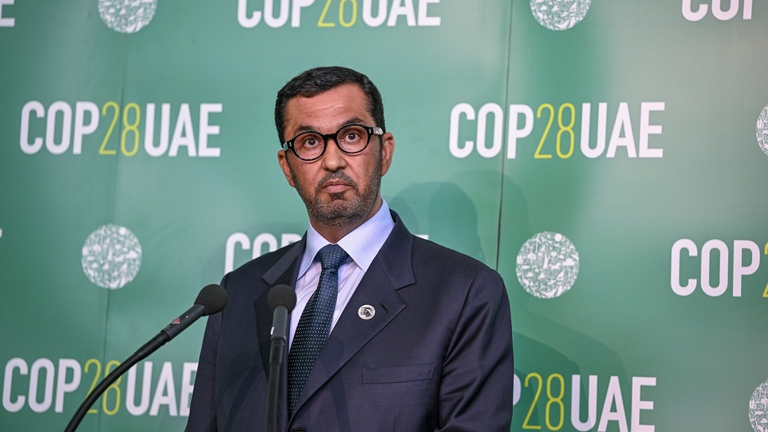
BONN, GERMANY – JUNE 8: Sultan Ahmed Al Jaber, President-Designate of the UNFCCC COP28 climate conference and CEO of the Abu Dhabi National Oil Company, speaks at a side event at the UNFCCC SB58 Bonn Climate Change Conference on June 8, 2023 in Bonn, Germany. The conference, which lays the groundwork for the adoption of decisions at the upcoming COP28 climate conference in Dubai in December, will run until June 15. (Photo by Sascha Schuermann/Getty Images)
It is slow both politically and, consequently, scientifically. One figure alone proves this: it took thirty years — from the 1992 Earth Summit in Rio de Janeiro to COP28 in Dubai in 2023 — for the words “fossil fuels” to be included in an official document, despite it being known for at least a century that they are responsible for most greenhouse gas emissions.
The deadlock since COP28 on phasing out fossil fuels
As if that were not enough, the final document of COP28 did not include terms such as “phase out” or “abandon” fossil fuels. Instead, it adopted the vague and widely criticized expression “transitioning away from fossil fuels”. This wording lacks concrete references and timelines and, as many analysts had already predicted in 2023, has not led to any tangible action in the years since. Not by chance, the Washington Post bluntly described it as “a victory for the fossil fuel industry”.
This explains the organizers’ desire to try an alternative path in Santa Marta. In essence: “Are COPs stalling? Then we move forward on our own.” Despite all the limitations already mentioned. Whatever the outcome of negotiations in Colombia, it will be difficult to see them as a real solution. The goal is to draft a roadmap for phasing out fossil fuels, in the hope that it might eventually be adopted by the three global economic and industrial giants.
Colombia’s Environment Minister: “The war in the Middle East shows the urgency”
“This conference is necessary, because COPs have not given us enough space to openly discuss an orderly and fair phase-out of fossil fuels. And we could not have imagined a better geopolitical context, as the war in the Middle East shows how urgent this issue is,” said Colombia’s Environment Minister Irene Vélez Torres.
Indeed, the conflict between the United States, Israel and Iran, and the resulting closure of the Strait of Hormuz, once again demonstrate how dependent the world is on hydrocarbons — and how dangerous that dependence is, not only for the climate. It remains to be seen, however, which governments are willing to accept this reality. Colombia certainly appears to be among them. As noted by the Spanish newspaper El País, the country is the world’s fifth-largest exporter of coal. The government in Bogotá therefore deserves credit for showing foresight and responsibility in this regard.
Vanuatu’s Climate Minister: “We need alternative means to save our people”
Più in generale, molte delle nazioni presenti appaiono pronte a riflettere “su degli strumenti atti a superare la dipendenza economica dalle fonti fossili, trasformando domanda e offerta e rafforzando la cooperazione internazionale”, osserva Climate Home News. Mentre il think tank britannico Carbon Tracker, si dice convinto che “il processo di Santa Marta” sia destinato “a far progredire la transizione”. Un’azione che è sempre più urgente, come ricordato anche dal Wwf.
More broadly, many of the countries present appear ready to reflect “on tools to overcome economic dependence on fossil fuels, transforming supply and demand and strengthening international cooperation,” as noted by Climate Home News. The British think tank Carbon Tracker believes that “the Santa Marta process” is likely “to advance the transition.” This is increasingly urgent, as also highlighted by WWF.
The world doesn’t lack climate conferences, it lacks delivery.
The #SantaMarta Conference is drawing a line on #FossilFuels, and challenging leaders to match words with action: clear timelines, strong policies, and real accountability.
“We are not getting anywhere in the formal climate negotiation process,” said Ralph Regenvanu, Climate Minister of Vanuatu, a Pacific archipelago threatened by rising sea levels. “We need to find other ways to move forward on phasing out fossil fuels, which will allow us to save our people.”
Countries present in Santa Marta include Canada, the United Kingdom, Norway and Brazil
In fact, countries with significant economic weight — such as Canada, the United Kingdom, Norway and Brazil — are also participating. Italy is also expected to be present, despite the not particularly green positions of the Meloni government. The uncertainty stems from the fact that, on one hand, Colombia has announced the presence of an Italian delegation; on the other, no official Italian government channels mention the event, as noted by Il Fatto Quotidiano.
Ministers from various countries are expected on April 28 and 29, alongside representatives of civil society, scientists, journalists, and the presidents of the upcoming COP30 and COP31. This signals an attempt to build a “bridge” toward future UN conferences. “This summit will not erase in five days a taboo that has persisted for thirty years in climate negotiations. But it is an original way to revive a topic that has stalled since COP28,” said Fanny Petitbon of the environmental organization 350.org — provided that the major powers absent from Santa Marta show concrete willingness to act. After all, solving the climate crisis would ultimately only require a G3.
The small Pacific island of Tuvalu is highly vulnerable to rising sea levels. At COP27, it demanded strict targets for the transition from fossil fuels.
As the weeks since the end of COP26 go by, there’s been more time to reflect on the Glasgow climate conference. And realise that all hope is not yet lost.
COP26 ended on Saturday 13th November, one day later than expected. Some positives and many negatives in the Glasgow Climate Pact, weakened by India’s last-minute change.