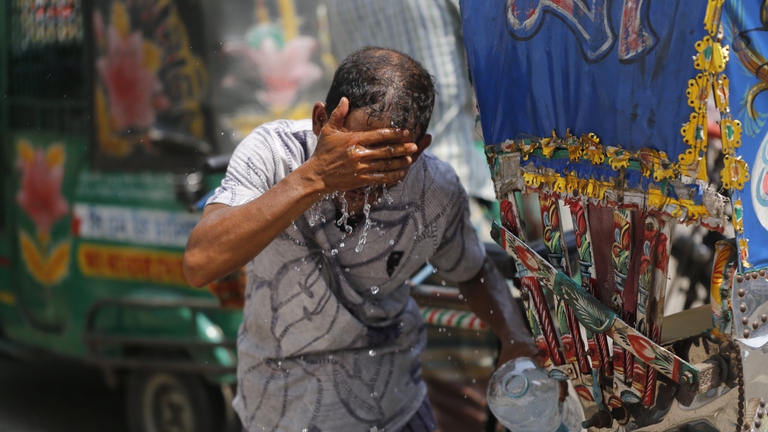
The climate crisis will affect everyone, but not in the same way. By 2050, extreme heatwaves caused by the rise in global average temperatures will be almost ubiquitous, especially in major cities around the world. But for those living in poorer countries, defending themselves will be much more difficult.
90 per cent of deaths will be concentrated in poorer countries
This is explained by a study from the Climate Impact Lab at the University of Chicago, in the United States, according to which total deaths linked to heat will be ten times higher in poorer nations than in wealthier ones. The analysis estimates that heat-related deaths will reach 391,000 per year in the former, compared to “just” 39,000 in the latter. In simpler terms, about 90 per cent of those who will not survive extreme heat will be concentrated in low- and lower-middle-income countries.
By 2050, the Global South will lose ten times more lives to extreme heat than the Global North.
That gap is not a coincidence. It is exactly what we mean when we talk about climate injustice
In Niger and Burkina Faso, heat-related deaths are projected to exceed current malaria… pic.twitter.com/FIAfeVGOUF
The report is based on data collected across 25,000 regions worldwide. It does not even assume the most alarming global warming scenarios: researchers considered an increase in global average temperature of 2.1°C compared to pre-industrial levels. Many analyses, as well as projections based on Nationally Determined Contributions (NDCs), instead point to a trajectory that could exceed 2.5°C.
“One of the cruelest ironies of climate change”
“This report highlights one of the cruelest ironies of climate change: it is expected to cause the deaths of millions of people in countries that have contributed the least to creating it,” said Michael Greenstone, one of the authors of the report. Historically, developing and poorer nations have emitted far lower amounts of CO₂, methane and other greenhouse gases than the Global North.
As is well known, access to air conditioning, “climate shelters”, and acceptable working conditions is not the same worldwide. Not to mention the quality of healthcare systems. And it is difficult to imagine that this situation will be radically transformed within the next twenty years.
In Pakistan, heat deaths will surpass those from strokes
Inoltre, lo studio indica che nei 25 paesi più colpiti, figurano numerose tra le nazioni più povere del Pianeta: è il caso di Bangladesh, Burkina Faso, Pakistan, Mauritania, Mali. In particolare in stati come il Niger i ricercatori parlano di 60 morti in più ogni 100mila abitanti. Ciò anche in ragione del probabile emergere di alcune malattie che si svilupperanno più facilmente grazie all’aumento delle temperature, a partire dalla malaria.
The study also shows that among the 25 most affected countries are many of the poorest nations, including Bangladesh, Burkina Faso, Pakistan, Mauritania and Mali. In countries such as Niger, researchers estimate 60 additional deaths per 100,000 inhabitants, also due to the likely spread of diseases that thrive in higher temperatures, starting with malaria.
Climate adaptation is crucial to protect human lives. Forecasts suggest poor countries will be hit much harder and see massive increases in death rates due to extreme heat. Helping poor countries to adapt to hotter climates is crucial. You want a cause worth investing in? Here it… pic.twitter.com/4Bj7vKcXNY
Similarly, in Pakistan, mortality linked to heatwaves could exceed deaths from strokes and respiratory diseases. Significant increases in mortality are also expected in European countries such as Spain, Italy, Greece, Moldova and Serbia, even though they are not among the poorest nations in the world.
The toll is still provisional, but data collected across several European countries indicate that tens of thousands of people have died as a result of extreme heat.
The latest State of the Climate in Europe report paints an alarming picture: the climate crisis is hitting the continent harder than the rest of the world.