From Somalia to Switzerland and the Himalayas: drought is becoming a growing threat
Water collection near Kismayo, Somalia @ Simon Maina/Afp/Getty Images
In many regions of the world, drought is causing mass displacement, wildfire risk and growing concerns over water supplies.
Water collection near Kismayo, Somalia @ Simon Maina/Afp/Getty Images
Nearly 62,000 people have been forced to leave their land in Somalia because of drought. The alarm was raised by the International Organization for Migration (IOM), which reports that three out of every four new displacements are now caused by lack of rainfall. This figure is up 22 per cent compared to last year, “confirming the growing severity of climate chaos” the IOM itself stated.
“When drought leaves no water or crops, fleeing becomes the only option”
The worst situation is currently being recorded in five provinces — Baidoa, Dayniile, Kahda, Diinsoor and Doolow. Overall, another 125,000 people are expected to flee drought conditions during the second quarter of this year alone.
“When water disappears, when crops fail and livelihoods are lost, the only option left is to leave. Without rapid action, drought will continue to increase vulnerability and worsen hunger across Somalia,” said Manuel Pereira, IOM chief of mission in the African nation.
In the five provinces mentioned, the situation is described as “disastrous.” And everything is directly linked to climate change, according to the United Nations itself. Since rainfall conditions show no signs of improving, the degradation of crops and livestock “is expected to intensify further in the coming months.”
Situation described as “disastrous” in five Somali provinces
The International Organization for Migration stresses that urban centers in neighboring regions are unable to cope with the sudden population increase and provide shelter for the tens of thousands of people arriving. “This forces many people to move yet again, settling in informal areas with extremely limited access to basic services,” the IOM added.
An analysis carried out in the Gedo region highlighted that many climate refugees are forced to travel long distances to reach water distribution points. Added to this is the growing loss of livestock, also due to the extreme heat conditions that often accompany these long journeys. This problem will inevitably have repercussions in the future as well, because even if weather conditions were to return to normal, the available resources would no longer be sufficient.
In Europe, 156,000 square kilometers affected by drought. “High danger” of wildfires in Switzerland
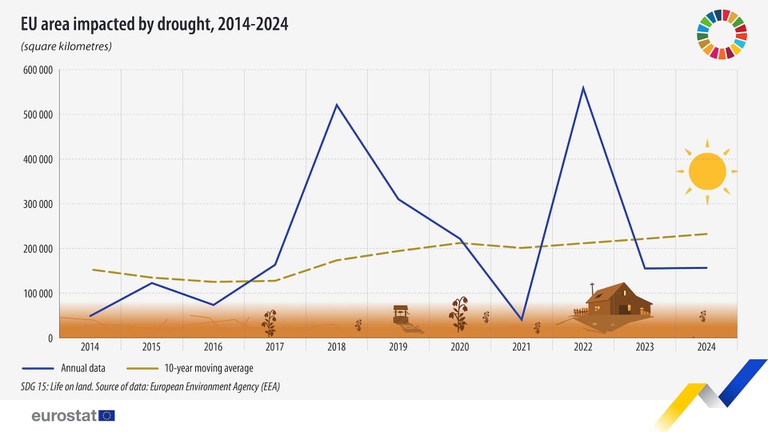
In Europe, as is well known, the means available to respond to crises are generally greater than in poor countries such as Somalia. Nevertheless, drought is equally present: according to an analysis by Eurostat, more than 156,000 square kilometers of European Union territory were affected by drought in 2024. Although this figure is lower than those recorded during some dramatic years of the last decade — especially 2018 and 2022 — the overall trend is clearly increasing.
Western Switzerland and the northern part of Ticino are currently experiencing severe drought conditions. The risk of forest fires has already reached level 4 out of 5, indicating “high danger.” In some regions, according to 24heures.ch, authorities have already imposed a total ban on outdoor fires, particularly in the Poschiavo and Bregaglia valleys.
From the Himalayas to North Korea, agriculture and water supplies at risk
On the other side of the world, insufficient rainfall conditions are also being recorded in the Himalayas. Until the end of January, no snow fell across the entire state of Uttarakhand, which hosts an important part of the mountain range. Similarly, neighboring Himachal Pradesh experienced its sixth driest year on record between 2025 and 2026. The snow deficit reached 40 per cent in Kashmir and 70 per cent in Ladakh.
#WIONClimateTracker | The Hindu Kush Himalaya is losing its snow reserves at an alarming rate
A new report by the International Centre for Integrated Mountain Development says snow cover has fallen nearly 28% below normal@JyotsnaKumar13 has further details on this pic.twitter.com/N79LdVfLcr
For all surrounding regions, this represents an enormous risk, because natural water reserves depend precisely on the snow cover formed upstream. An entire ecosystem is under threat — not only agriculture and livestock farming, but also, for example, the production of medicinal plants.
Likewise, a severe drought situation is unfolding in North Korea. The state news agency KCNA explained that “an abnormal situation persists across much of the country. This is a phenomenon rarely observed in previous years. Workers in various regions are concentrating their efforts on protecting crops.”
The oil giant TotalEnergies must defend itself against accusations of failing to take into account the climate consequences resulting from the use of its products.
From Australia to the United States, from Chile to Mozambique, and from Russia to Argentina, many countries are grappling with extreme weather conditions.
A Greenpeace report denounces Russia’s political and economic model: a nexus of extractivism, authoritarianism and war that is destroying the environment, with serious repercussions for the global ecosystem.