



Pescasseroli, in the heart of Italy’s Apennines, will host the IBA conference on bear conservation and human–bear coexistence. LifeGate will be the event’s media partner.
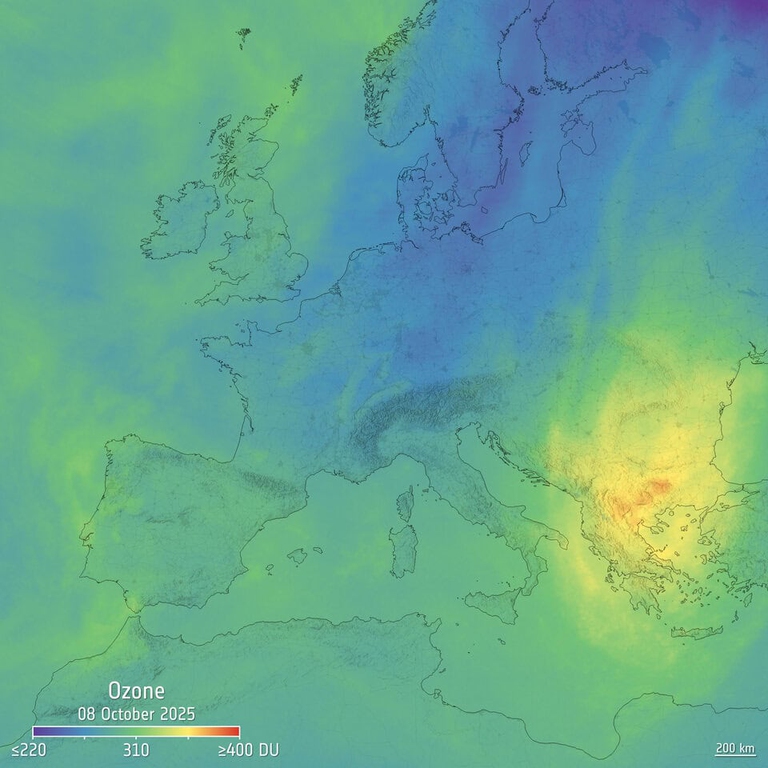
The first images from Sentinel-4 have arrived, the satellite that will allow us to monitor Europe’s air quality from space.
Europe’s new Copernicus Sentinel-4 satellite sends back its first images from space, marking a major milestone for air quality monitoring in Europe.
Launched in July 2025, Sentinel-4 is part of the first European space mission to provide hourly observations related to air quality. Unlike polar-orbiting satellites, which pass over the entire planet at low altitude, Sentinel-4 operates from a geostationary orbit at around 36,000 kilometers above Earth, continuously observing the same region: Europe and North Africa.
The first images released by the European Space Agency (ESA) show the distribution of major air pollutants over the European continent, including nitrogen dioxide, sulfur dioxide, and ozone.
Once fully operational (it is currently in the initial “commissioning” phase), the satellite will deliver crucial data for atmospheric research, climate modeling, and European environmental policies. Sentinel-4 is part of the broader Copernicus programme, developed by the European Commission and ESA to provide open-source data on Earth’s environment. Its observations will support the air quality forecasting services of the Copernicus Atmosphere Monitoring Service (CAMS), contributing to public health prevention and urban planning.
With Sentinel-4, Europe will be able to rely on a continuous, high-resolution atmospheric observation system—an important step forward toward a more accurate understanding of the air we breathe and the impacts of human activities on the climate.
Siamo anche su WhatsApp. Segui il canale ufficiale LifeGate per restare aggiornata, aggiornato sulle ultime notizie e sulle nostre attività.

Quest'opera è distribuita con Licenza Creative Commons Attribuzione - Non commerciale - Non opere derivate 4.0 Internazionale.
Pescasseroli, in the heart of Italy’s Apennines, will host the IBA conference on bear conservation and human–bear coexistence. LifeGate will be the event’s media partner.
The inflation caused by extreme weather events is known as “climateflation”: prices for many food products are expected to rise sharply.
The toll is still provisional, but data collected across several European countries indicate that tens of thousands of people have died as a result of extreme heat.
Last February, Malaysia imposed a total ban on electronic waste imports. Yet toxic e-waste continues to arrive from the United States and other countries through illegal trafficking networks.
Although Earth Overshoot Day falls six days later than in 2025, this does not represent an improvement. The shift is the result of revised estimates of the oceans’ carbon absorption capacity, while humanity’s actual ecological footprint continues to grow.
Gigantic wildfires in France’s Gironde region and near Madrid, Spain, have devastated tens of thousands of hectares of vegetation.
Greece has launched a wildfire management system based on nanosatellites and artificial intelligence. A model that other countries are now looking to replicate.
According to analysts, the emergence of a “super” El Niño could trigger a global food price shock, adding to inflationary pressures already fuelled by the conflict with Iran.
Residents of Kanseche, Malawi, accuse ABF of contributing to the devastating 2022 floods through its subsidiary, Illovo Sugar.


