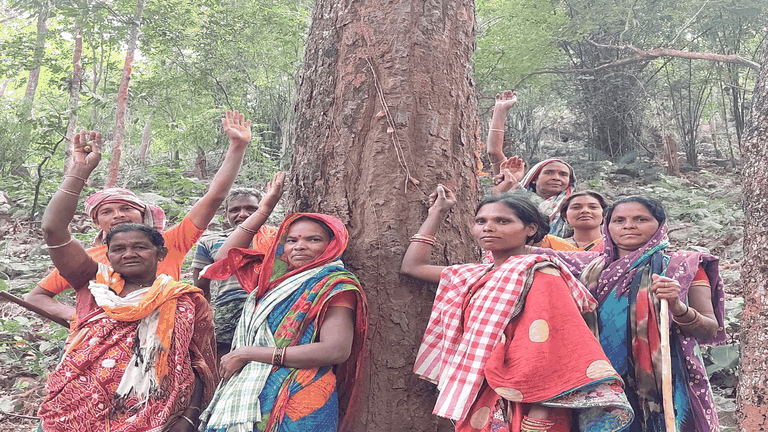
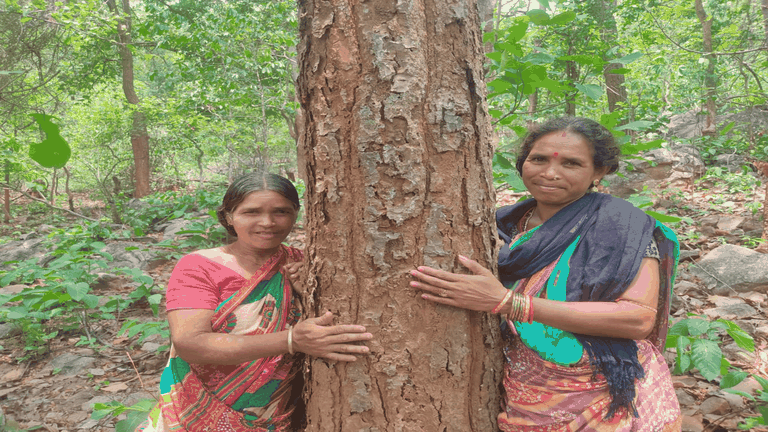
Sukanti Behera is happy nowadays as the forest located near to her house offers her firewood that helps her to reduce daily burden of collecting fire woods from distance forest areas.
The 55-year-old homemaker resides in Dasapalla block off Nayagarh district in Odisha, State of India, around 995 miles from Delhi, the Nation’s capital.
“Earlier, we used to spend money to buy the cooking oil and it was too difficult to afford due to paltry income. I do odd jobs for livelihood and the income is barely enough to run the family. But the spending on cooking oil has been saved due to the revived forest that offers us firewood.”
Sukanti Bera
She, however, is not alone as around 3.000 households comprising over 15.000 individuals and living in eighty villages of the block has been working tirelessly for the past six years to rejuvenate forests.
Their efforts have now begun to reap results as the forest is not only providing firewood but have also been offering fruits and other items for their consumption and livelihood. Besides, the villagers also wake up to the melodious sound of the birds in the morning.
Protecting forests in a unique way
Villagers who hail from the tribal community attribute the revival of the forest to a unique concept known as thengapalli that translates “to turn with stick”. The concept involves patrolling the community forest with sticks to deter timber thieves and other destructive activities.
Villagers say that the practice has helped them to not only revive the forest but have also been offering them livelihood .
“We were disturbed by the destruction in the forest due to illegal activities. The forest cover was getting depleted with each passing day that made us unhappy”.
“We decided to revive the forest through thengapalli technique and began to create awareness in the community. We (women) were at the forefront of the movement as men often migrate for work. The revival of forest was necessary for environment protection and also for our daily needs,” said Uttasa Mallika, 43, a villager.
The women began patrolling by using sticks which was a symbol of their responsibility to patrol and protect their community forests, “The sticks was not used for violence but rather a symbolic representation of our commitment to guard the forest from illegal activities like timber theft. We roam in the group of three to six to drive the thieves away,” she added.
Besides, women have also taken up another commendable initiative by keeping earthen pitchers on tree barks for birds in scorching summers, “We had found that birds were feeling thirsty during unrelenting summers. We decided to place the pitchers filled with water on the tree barks. It helped us to increase their numbers in the area,” said Namita Kanhar, 40, a home maker.
In more than 15k tribal villages of Odisha, villagers protect forests through traditional https://t.co/ymZvT4MNiO of those practices is Thengapalli- a rotational forest patrolling system used by tribal women to guard their forest against smugglers, poaching and the timber mafia. pic.twitter.com/6mXsAaIU12
Sajani Mallika, 32, a homemaker said that the patrolling is being done as per schedule fixed beforehand and the sticks are kept outside the houses of the group who are supposed to go on patrolling the next day, “the sticks are reminders to the group that their turn is next, to ensure no one misses their task. The consistency in patrolling has helped us in reviving the forest and we have hardly missed our routine in the past six years when the thengapalli resumed here.”
The movement, however, is not new as it was initiated in the State way back in the Seventies but became popular when women came forward and joined the movement in the Nineties. The practise, a form of community-based forest management, demonstrates a strong commitment to conservation and sustainable resource use.
The women had taken up forest management long before the Forest rights act (Fra) was enacted in 2006. The Act gives these communities the right to use and manage traditionally held forest lands.
Reviving forests and biodiversity
Prashant Mohanty, executive director of Nirman, a non-profit working for the local communities in Odisha said, they undertook the effort to mobilize and create awareness among the tribals about the thengapalli campaign six years ago, “We found that these forest fringe communities were losing their connection with the forest and biodiversity was also decreasing. The numbers of wild animals were also on a decline and forest fires were increasing. We decided to do something about it and planned to revive the thengapalli movement that was made success by the women of our State.”
“We began to create awareness among the women and explained them about the benefits of having a green forest cover that would offer them firewood and also provide several fruits and other items. They agreed and joined the movement. Their patrolling and dedication has brought a rapid change and has revived the forest,” he added.
He claimed that several animals like wild boars, elephants and deers are being cited and villagers have also started doing farming in a small portion of the forest for livelihood.
Environmentalists have hailed the move and called it exemplary.
“Such initiates are a welcome relief and reaffirms our belief that environment can be saved if sincere efforts are taken.
Tuhin Subhra Mandal
“I urge more people to come forward and safeguard our forests which are fast losing their natural cover due to rapid deforestation and urbanization. These women stand as an example for the society to follow,” said Tuhin Subhra Mandal, an environmentalist.
India has lost 1.003.000 hectares of humid primary forest which is 1.4 per cent of its total tree cover loss between 2019 and 2024. In fact, the country lost 18,200 hectares of primary forest in 2024 as compared to 17,700 hectares in 2023.
Pescasseroli, in the heart of Italy’s Apennines, will host the IBA conference on bear conservation and human–bear coexistence. LifeGate will be the event’s media partner.
The toll is still provisional, but data collected across several European countries indicate that tens of thousands of people have died as a result of extreme heat.
Last February, Malaysia imposed a total ban on electronic waste imports. Yet toxic e-waste continues to arrive from the United States and other countries through illegal trafficking networks.
Although Earth Overshoot Day falls six days later than in 2025, this does not represent an improvement. The shift is the result of revised estimates of the oceans’ carbon absorption capacity, while humanity’s actual ecological footprint continues to grow.
Greece has launched a wildfire management system based on nanosatellites and artificial intelligence. A model that other countries are now looking to replicate.
According to analysts, the emergence of a “super” El Niño could trigger a global food price shock, adding to inflationary pressures already fuelled by the conflict with Iran.