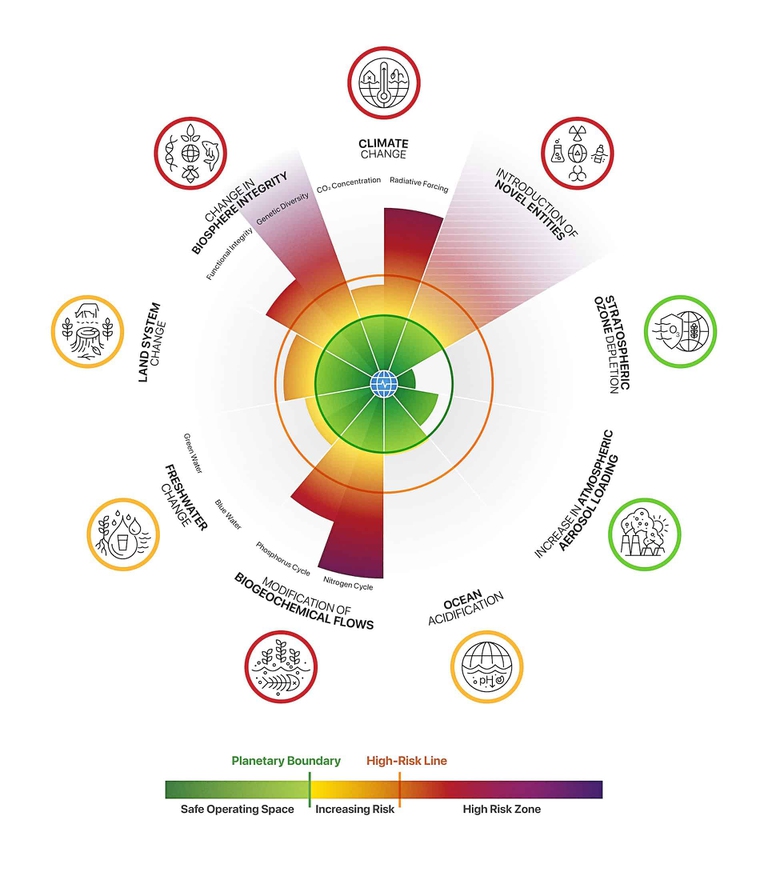
Earth has crossed the seventh of nine “planetary boundaries”, so defined because they are capable of threatening the planet’s overall balance and, consequently, its habitability. After climate change, biosphere integrity, land-use change, the alteration of biogeochemical cycles (nitrogen and phosphorus), the use (and pollution) of freshwater, and the spread of new chemical pollutants, it is now the turn of ocean acidification.
Acidità in aumento del 30-40 per cento sulle superfici dei mari
Acidity increasing by 30–40 percent at the ocean surface
This was revealed on September 24 by the new Planetary Health Check report, published by the Potsdam Institute, which monitors the status of the nine planetary boundaries defined in 2009 by researchers at the Stockholm Resilience Centre in Sweden. The report explains that the pH of the ocean surface has decreased by about 0.1 units compared with the pre-industrial period, roughly the mid-19th century. This corresponds to an increase in acidity of 30–40 percent.
A chart showing Earth’s planetary boundaries
This is a harmful phenomenon for a wide range of ecosystems, starting with the most vulnerable ones, such as coral reefs, whose loss would entail the disappearance of an enormous amount of the biodiversity they host. But flora and fauna are also under threat, for example in the Arctic region.
Pteropods, the “sentinels” of ocean acidification
Some animal species already show signs of ocean acidification: this is the case of pteropods, shell-bearing mollusks that play a particularly important role in the marine carbon dioxide cycle. It is precisely their shells that exhibit the typical characteristics of deterioration caused by changes in pH. Pteropods are a fundamental food source for numerous species; as a result, their decline could disrupt the entire food chain, with impacts also on fisheries and human beings.
World’s oceans fail key health check as acidity crosses critical threshold for marine life.
Scientists call for renewed global effort to curb fossil fuels as seven of nine planetary boundaries now transgressed.https://t.co/rT4D8zAyo2
But that’s not all: ocean acidification will also trigger a vicious cycle in relation to global warming. Oceans around the world absorb a large share of the excess CO₂ released into the atmosphere due to human activities. And the more acidic the waters become, the less capable they are of performing this function. “For billions of years, the oceans have ensured Earth’s climate stability. That’s why this is a red alert for our planet,” explained oceanographer Sylvia Earle.
“The system that stabilizes Earth is under increasing pressure”
“The dynamics we are observing are really moving in the wrong direction. Acidification, declining oxygen levels, and the multiplication of marine heatwaves are increasing the pressure on a system that is fundamental to stabilizing Earth’s conditions,” echoed Levke Caesar, a scientist at the Potsdam Institute and one of the report’s main authors. This is why inaction by governments around the world amounts to a deliberate choice: responsibility for the planet’s future depends on the decisions made today.
Pescasseroli, in the heart of Italy’s Apennines, will host the IBA conference on bear conservation and human–bear coexistence. LifeGate will be the event’s media partner.
The toll is still provisional, but data collected across several European countries indicate that tens of thousands of people have died as a result of extreme heat.
Last February, Malaysia imposed a total ban on electronic waste imports. Yet toxic e-waste continues to arrive from the United States and other countries through illegal trafficking networks.
Although Earth Overshoot Day falls six days later than in 2025, this does not represent an improvement. The shift is the result of revised estimates of the oceans’ carbon absorption capacity, while humanity’s actual ecological footprint continues to grow.
Greece has launched a wildfire management system based on nanosatellites and artificial intelligence. A model that other countries are now looking to replicate.
According to analysts, the emergence of a “super” El Niño could trigger a global food price shock, adding to inflationary pressures already fuelled by the conflict with Iran.