El Niño is certainly approaching. An episode of the phenomenon — which consists of an increase in sea surface temperatures in the tropical Pacific Ocean — is “increasingly likely,” according to the World Meteorological Organization (WMO) at the end of April, a conclusion confirmed by forecasting models from the European Copernicus service, the U.S. National Oceanic and Atmospheric Administration (NOAA), and Columbia University.
The UN agency explicitly referred to “a clear shift in the equatorial Pacific” and to “rapidly rising sea surface temperatures.” Nevertheless, “El Niño has not yet been officially declared, although it is likely to happen soon,” explains Luca Lombroso, meteorologist at the Geophysical Observatory of the University of Modena and Reggio Emilia.
What is El Niño, named by Peruvian fishermen?
As mentioned, the phenomenon is a natural variation in ocean temperatures in the equatorial Pacific region. El Niño is essentially the opposite of La Niña, which is characterized by lower-than-average temperatures. These changes are associated with shifts in global atmospheric circulation and, at times, extreme weather events in various regions, particularly in Latin America.
It is a cyclical phenomenon that occurs roughly every two to seven years. The most recent episode — particularly intense — lasted from the summer of 2023 to the spring of 2024. Its name comes from Peruvian fishermen, who were the first to notice the phenomenon because it affected fish populations in the ocean. Since it often begins around December, they named it El Niño in reference to the Christ Child, known in Spanish as El Niño de Navidad.
How scientists measure El Niño events
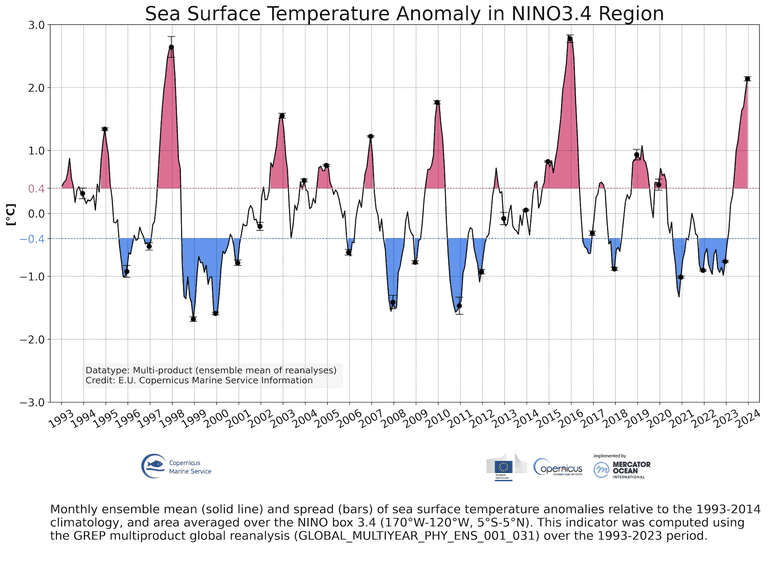
In more recent times, scientists have developed a specific index to monitor conditions in the equatorial Pacific, known as the Niño 3.4 Index. It is calculated based on the average sea surface temperature anomaly in the region between 5° North and 5° South latitude and between 170° West and 120° West longitude.
EL NIÑO WATCH: Issued by Climate Prediction Center today saying 82% chance of El Niño developing May-July of this year & 96% chance continuing through winter (Dec. 2026-Feb 2027). Peak strength is uncertain. El Niño: warmer than average sea surface temps in equatorial Pacific. pic.twitter.com/YYuu8ae7I0
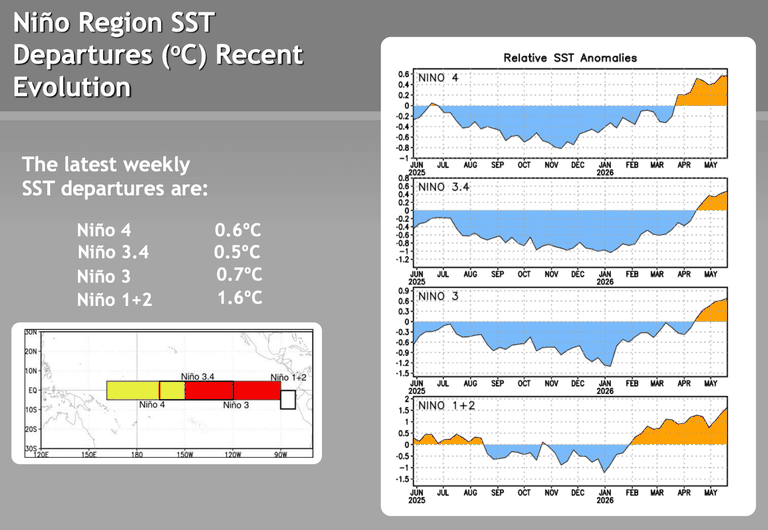
“The Niño 3.4 Index,” explains the U.S. National Center for Atmospheric Research, “typically uses a five-month average, and El Niño or La Niña events are defined when sea surface temperatures in the region deviate by at least 0.4°C for six months or longer.” In the current case, the index stood at -1°C at the end of last year. During the first months of 2026, however, it rose rapidly, reaching +0.5°C in April. Forecasts suggest it may continue to increase in the coming months.
The extensive marine heat wave in the Pacific — part of the Pacific Meridional Mode — will join forces with a developing super El Niño into fall.
That's expected to fuel many hurricanes in the eastern Pacific, whose moisture could end up in California and the Intermountain West. pic.twitter.com/Xdr3RLqy8P
“It is likely that El Niño will be officially declared starting from the April-May-June quarter, or from the following period covering July,” Lombroso explains. At present, the phenomenon is in a “moderate” phase, but the chances that it could become “extreme” — what scientists call a “super El Niño” — are very high for the autumn.
Past events: from the 1997–1998 super El Niño to the 2015–2016 event
For the September-October-November period, there is currently a 35 percent chance of a temperature anomaly of between +1.5°C and +2°C in the equatorial Pacific, and a 20 percent chance that anomalies could exceed +2°C. There is also a very high probability (95 percent) that the event will persist into the winter period from December to February.
Temperatures variations in the Tropical Pacific due to El Niño @ Noaa
This would not be unprecedented. In 2015–2016, anomalies exceeded +2.5°C, according to experts Jeff Masters and Bob Henson of Yale Climate Connections. The strongest El Niño on record occurred in 1997–1998, and in a 2000 study the World Health Organization estimated that between 21,000 and 24,000 premature deaths could be attributed to that event.
Can El Niño affect the global climate and European summer temperatures?
Although El Niño is geographically confined to a specific area, it can influence weather patterns worldwide. When it occurs, wetter-than-normal conditions are typically observed along the western coasts of Latin America, in the Horn of Africa, and in the southern United States. By contrast, rainfall tends to decrease in Australia and across the Amazon basin.
If the event is particularly intense, it can also contribute to a further rise in global average temperatures. For this reason, 2027 could potentially become the hottest year on record — primarily because of climate change, but also with some additional warming contributed by El Niño.
However, this concerns next year, not the current one. There is no proven connection between the current development of El Niño and the weather conditions Europe will experience this summer. “Whatever happens during the summer in Europe, including Italy, El Niño cannot be blamed. Even if it were officially declared immediately, its effects would be delayed. Moreover, the consequences for Italy are particularly uncertain: for example, El Niño was absent during the scorching summers of 2003 and 2012. In short, these correlations have not been demonstrated,” Lombroso explains.
Extreme heat waves are caused by climate change, not El Niño
A slightly different — though still cautious — discussion can be had regarding autumn and winter. “Even in this case, dramatic cause-and-effect relationships are not certain. However, some researchers argue that they do exist. Generally speaking, El Niño tends to bring drier winters to Italy, beginning in the north but affecting the entire peninsula,” Lombroso adds.
El Niño will occur, therefore, and it is certainly not good news for the global climate. But the real bad news is something else entirely: we continue to burn coal, oil and gas as if science had not been warning us for more than half a century about the climate crisis these fuels cause. And it is precisely fossil fuels that are responsible for the extreme heat waves we experience — not geographically and temporally limited phenomena such as El Niño.
The toll is still provisional, but data collected across several European countries indicate that tens of thousands of people have died as a result of extreme heat.
The latest State of the Climate in Europe report paints an alarming picture: the climate crisis is hitting the continent harder than the rest of the world.