Two powerful earthquakes have left at least 1,450 people dead and 50,000 missing in Venezuela. The country’s ongoing economic and social crisis is also hampering rescue operations.
In Venezuela, the situation is becoming increasingly dramatic after the two earthquakes of 24 June. Within the space of a minute, two tremors measuring 7.2 and 7.5 on the Richter scale, triggered by the contact between the Caribbean tectonic plate and the South American plate, struck the Venezuelan state of Yaracuy, a few dozen kilometres from the capital Caracas. Hundreds of buildings collapsed, partly because of the unsafe materials with which they had been built. Gas leaks caused fires and blackouts, also due to the country’s obsolete infrastructure, while the healthcare system, which has been collapsing for decades, is proving unprepared to manage the emergency.
The provisional toll is more than 1,400 dead, over 3,000 injured and thousands displaced. The most worrying figure, however, is the number of missing people, estimated at around 50,000. Dozens of countries around the world, including the United States, have sent aid to Venezuela. But the country is in chaos, making rescue coordination difficult, while the window for finding survivors has now closed.
The first earthquake struck at 6:04 p.m. local time. It had a magnitude of 7.2 on the Richter scale, with its epicentre near the city of San Felipe at a depth of around 20 kilometres. Just 39 seconds later, the area was hit by an even stronger and shallower earthquake. The second tremor measured 7.5 on the Richter scale, at a depth of 10 kilometres, with its epicentre in the village of Yumare. According to measurements, this was the strongest earthquake to hit the country since 1900.
The two tremors were felt as far away as Brazil, where some buildings were evacuated, and were followed by hundreds of aftershocks that also triggered a tsunami warning. Northern Venezuela, where the epicentre was located, lies on the contact line between two huge slabs of the Earth’s crust: the Caribbean plate and the South American plate. These plates move laterally by tens of millimetres each year, and because their edges are not smooth lines but fractured rock, blocks along the two faults can remain stuck for long periods. The pressure, however, does not stop. This leads to the accumulation of huge amounts of energy, which are then released in the form of an earthquake once the rupture occurs. This is exactly what happened on 24 June in Venezuela, a territory that has always been highly vulnerable to earthquakes.
A dramatic tool
The earthquakes that struck Venezuela had devastating consequences. The president of the National Assembly, Jorge Rodriguez, said that at least 189 buildings had collapsed and thousands more had been damaged. Gas leaks caused fires and explosions, electricity went out in several areas of the country, and internet connections, already limited by the regime, are intermittent.
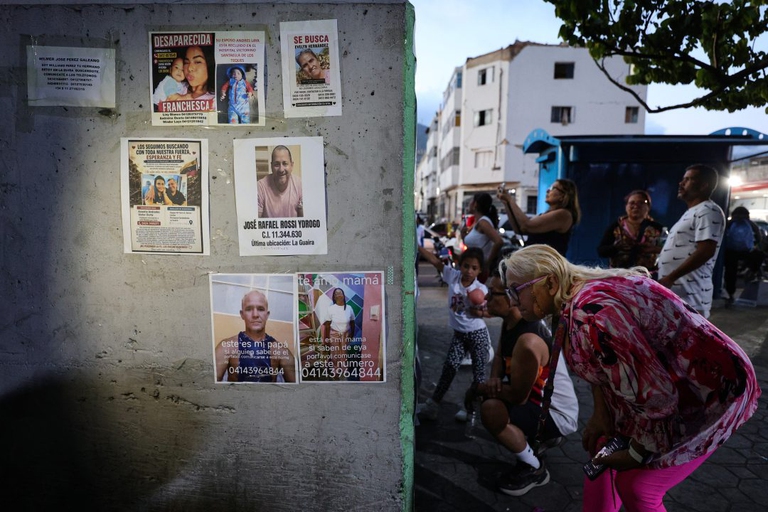
The toll from the earthquakes, updated on the evening of 28 June, stands at at least 1,450 dead, 3,200 injured and more than 3,000 displaced. The most worrying figure, however, concerns the missing, estimated at around 50,000. An online platform called desaparecidosterremotovenezuela.com has been launched to report and search for missing people. There, people can enter the personal details of loved ones or acquaintances who have disappeared after the earthquake. Anyone with information can contribute it in order to simplify search efforts.
🚨🇻🇪 UPDATE: More shocking footage out of Venezuela from last week's devastating earthquakes…
At least 1,450 people are dead, 3,150 are injured, and nearly 50,000 are missing.
It was the worst earthquake to hit the country in a century, back-to-back 7.2- and 7.5-magnitude…
La presidente Delcy Rodriguez, insediata a inizio 2026 dopo il colpo di stato con cui gli Stati Uniti hanno destituito Nicolás Maduro, ha dichiarato lo stato d’emergenza. L’Onuha già stimato danni per 6,7 miliardi di dollari, circa il 6 per cento del Pil del Venezuela. Un dato che prende in considerazione solo le perdite patrimoniali ma che non include le ripercussioni economiche.
President Delcy Rodriguez, who took office at the beginning of 2026 after the coup with which the United States removed Nicolás Maduro, has declared a state of emergency. The UNhas already estimated damages at 6.7 billion dollars, around 6 per cent of Venezuela’s GDP. This figure takes into account only material losses and does not include the broader economic repercussions.
Economic and humanitarian crisis
The devastation caused by the two earthquakes has two sets of causes. The first is geological: the two tremors occurred in rapid succession, within a few seconds of each other, and at shallow depth. This effectively amplified their power.
The media are publishing satellite images showing the aftermath of the earthquake in Venezuela. pic.twitter.com/EAQj0h8E7U
But behind the tragedy there is also a political dimension. The fact that hundreds of buildings collapsed and thousands more were damaged is linked to the poor-quality materials used to build homes, such as polystyrene or clay blocks and other substandard materials, as well as the lack of ordinary maintenance and the failure to comply with, or total absence of, anti-seismic regulations. These elements are tied to the deep economic crisis Venezuela has been experiencing for decades, caused by corruption and the failed policies of its socialist ruling class, but also and above all by suffocating US sanctions. The regime change imposed by Washington in January 2026 has not changed the situation, as the economy has continued to struggle during the first half of the year.
Healthcare system on the brink
If these are the causes of the collapses, another problem concerns rescue efforts. Venezuela’s healthcare system has long been in crisis, with as much as 60 per cent of the population lacking access to healthcare. The economic crisis and healthcare difficulties themselves have driven thousands of doctors and nurses to emigrate, and today the system is kept running largely by volunteers, who account for around 70 per cent of the workforce. Available equipment is lacking because of a past marked by poor investment and failed planning. One example is the fact that in Caracas, a city that reaches almost 6 million inhabitants if the entire metropolitan area is counted, there are only three public ambulances. More broadly, one hospital in three lacks emergency supplies.
The two earthquakes have further complicated the already difficult work of hospitals. Data indicate that at least thirteen hospitals were damaged and that facilities have been forced to operate amid power outages, phone lines out of service and no running water. Venezuelan authorities have mobilised rescue operations, but criticism is also mounting on this front, with reports denouncing the absence of heavy machinery and other vehicles needed to dig through the rubble. In the cities most affected by the collapses, the population itself has stepped in, digging through debris with bare hands or makeshift tools, forming human chains to clear collapse sites of rubble. In some cases, however, this has slowed the work of official rescue teams.
Large amounts of aid are also arriving from abroad. At least 24 countries have organised the shipment of economic, human and logistical resources to Venezuela. Among them are the United States, which was hostile to Venezuela for a long time but later normalised relations, also lifting several sanctions, after removing Maduro last January. Washington has sent ships, helicopters and heavy transport aircraft, as well as civilian teams.
Italy’s Ministry of Defence has also made a flight available to transport aid to Caracas, while at least 140 dogs from 21 countries have been mobilised to assist search and rescue operations. However, the fact that Caracas’ main airport was damaged by the earthquakes, and that movements are often hindered by congested traffic and rubble, is delaying the arrival and deployment of rescue teams.
Pescasseroli, in the heart of Italy’s Apennines, will host the IBA conference on bear conservation and human–bear coexistence. LifeGate will be the event’s media partner.
The toll is still provisional, but data collected across several European countries indicate that tens of thousands of people have died as a result of extreme heat.
Last February, Malaysia imposed a total ban on electronic waste imports. Yet toxic e-waste continues to arrive from the United States and other countries through illegal trafficking networks.
Although Earth Overshoot Day falls six days later than in 2025, this does not represent an improvement. The shift is the result of revised estimates of the oceans’ carbon absorption capacity, while humanity’s actual ecological footprint continues to grow.
Greece has launched a wildfire management system based on nanosatellites and artificial intelligence. A model that other countries are now looking to replicate.
According to analysts, the emergence of a “super” El Niño could trigger a global food price shock, adding to inflationary pressures already fuelled by the conflict with Iran.