



Pescasseroli, in the heart of Italy’s Apennines, will host the IBA conference on bear conservation and human–bear coexistence. LifeGate will be the event’s media partner.
Its oceanic microclimate, fertile soils, and the alternation of rain and sunshine make Normandy the ideal place for flax cultivation. A journey through the region offers a close-up look at the European flax supply chain, from cultivation to fibre processing.
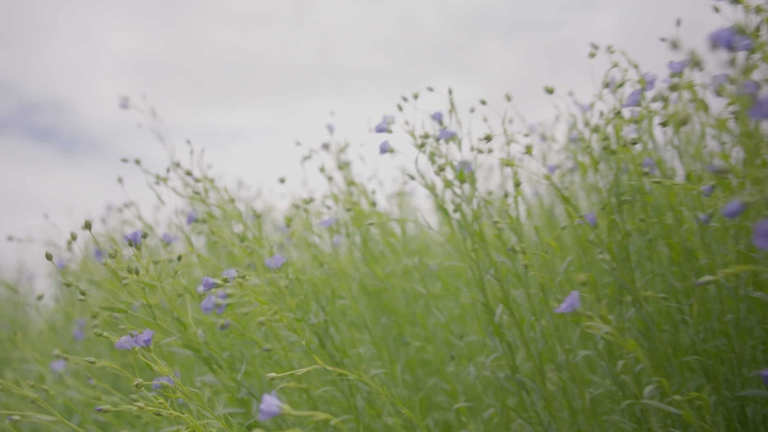
There is a moment of the year, in mid-June, in Normandy, when the fields turn a soft yet vibrant blue. It is the flax flowering season: it lasts no more than about ten days, and the flowers bloom in the morning and fade by evening. An ephemeral spectacle, yet enough to imprint itself on memory as one of the purest and quietest sights that the French countryside can offer. We are in the Somme, a French department in the Hauts-de-France region. For those departing from Paris, the destination is Martainneville, a peaceful village just a few kilometres from Abbeville. It is here that Calira, the Coopérative Agricole Linière de la Région d’Abbeville, is based—a cooperative specialised in the cultivation and processing of textile flax, serving farmers (700 are members of the cooperative) who have worked this land for generations.
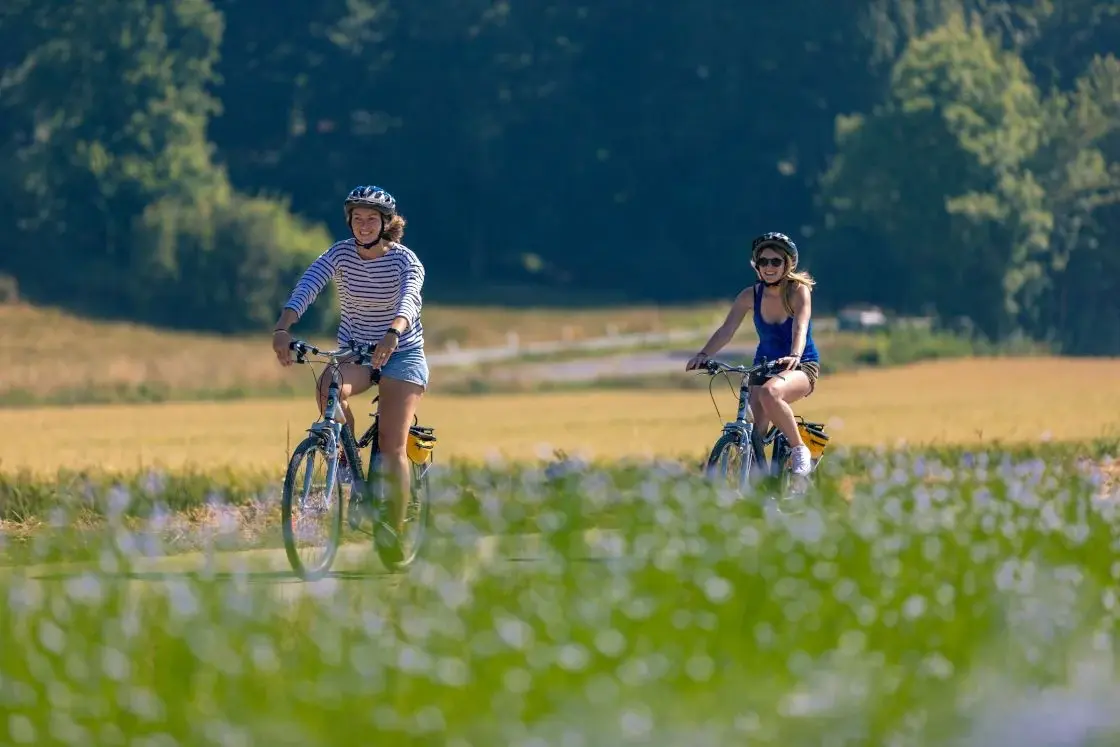
But the journey to discover flax offers many opportunities. One is to follow the Véloroute du Lin, cycling slowly and in silence through this blue ocean, ideally at dawn, along dirt tracks cut between the fields near the coast. It is a circular route starting from Hautot-sur-Mer, leading to Offranville via the greenway and then to the beautiful village of Varengeville and the beach of Pourville along small roads. Flax fields alternate with stretches along the English Channel, following the spectacular Alabaster Coast, famous for its imposing white chalk cliffs overlooking the sea. Not far away, the Maison du Lin in Routot is also worth a stop, where every June the Festival du Lin is held, featuring markets, guided tours and meetings with local flax producers.
The journey to Abbeville is already, in itself, a lesson in agricultural geography. From the train window leaving Paris northbound (the journey takes about 40 minutes), the landscape gradually changes: forests give way to vast cultivated plots, and among wheat and rapeseed appear those blue-violet rectangles gently swaying in the wind. In Europe there are 90,000 hectares cultivated with flax, mainly from southern Normandy northwards to Belgium and the Netherlands, an area that represents 80 per cent of global production with 7,500 farms dedicated to the crop.
This is no coincidence: this strip of Atlantic land, with its silty soils, rainfall spread throughout the year and temperatures that are never too extreme, offers conditions that no other area in the world can replicate with the same quality. For this reason, flax grown in Western Europe is known as the best in the world.
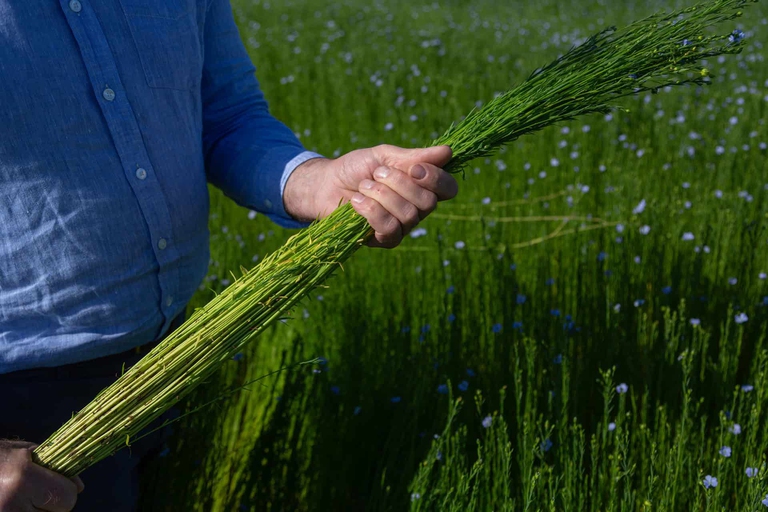
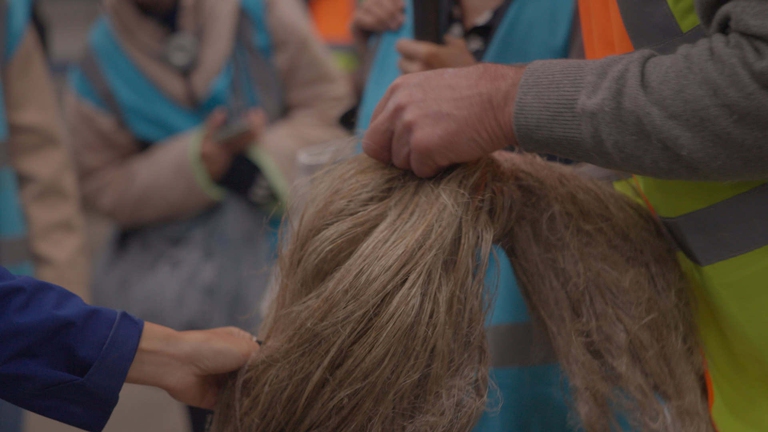
“Here we do not simply work a plant,” explains Vincent Boche, President of the Calira cooperative, “we tell the story of a territory.” The visit begins in the warehouses where the rows of straw are stored, laid out in the sun for weeks before entering production. Unlike many other crops, flax is harvested by pulling out the entire plant, roots included, in order to preserve the maximum length of the fibres. After harvesting, the straw is left in the fields: the combined action of dew, rain and soil microorganisms starts a natural fermentation process that separates the fibres from the stems. It is an ancient, respectful and extremely slow process. Then comes scutching.
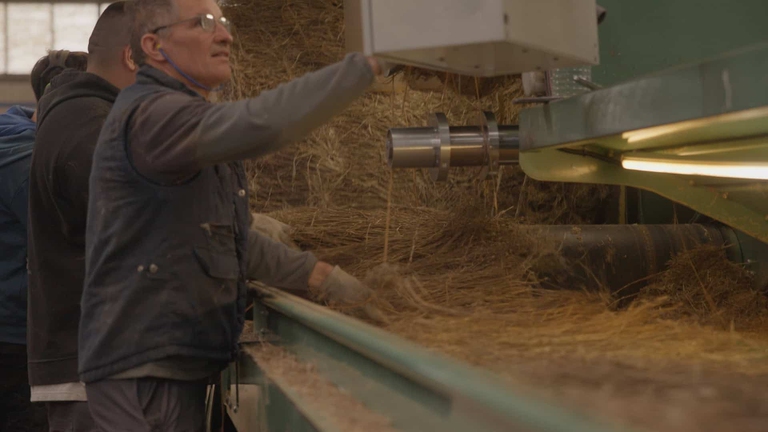
Inside the plant, imposing machines work tirelessly alongside the skilled gestures of the operators. The process separates the long fibres from the woody part of the stem and from the shorter fibres, known as tow. Nothing from this earth-scented fibre is wasted: besides textiles, flax tow, a by-product of scutching and combing, is used to make rope and twine and for paper production. Not to mention flax oil, flour and seeds, which have many uses, including herbal remedies.
The heart of the product, the most “noble” part of flax, is the long fibres. These are the fibres mainly exported around the world: 95 per cent of production ends up in Asia and supplies numerous spinning mills producing high-quality fabrics. But long fibres also tell the story of an unexpected industrial future: flax fibre is very light and offers a significant weight advantage in composite materials. Its vibration-absorbing properties give it a very interesting advantage over carbon fibre, which does not absorb vibrations. This characteristic opens up possibilities for the use of flax fibre in the railway industry and in numerous sporting goods such as tennis rackets, skis and bicycle frames.
Then there are the short fibres, which have equally versatile applications: they are used in blended spinning (flax-cotton, flax-wool, flax-polyester), in agromaterials as felt for acoustic and thermal insulation in construction, and in paper manufacturing. Seeds, processed in pressing facilities, are used to extract oil, a valuable ingredient rich in Omega-3. Finally, the shives—the fragments of the woody stem—are used as raw material for particleboard panels, animal bedding for horses and poultry, and horticultural mulches.
Camminando tra i macchinari, si capisce perché il lino venga considerato una fibra modello per l’industria tessile. Rispetto alla coltivazione del cotone si risparmiano 650mila metri cubi di acqua e 300 tonnellate di prodotti fitosanitari, perché il lino ha bisogno solo dell’acqua piovana e non richiede l’uso di pesticidi. L’energia utilizzata per la produzione della fibra è dal 4 al 10 per cento di quella necessaria per le fibre sintetiche, e le piantagioni assorbono 250mila tonnellate di CO₂ ogni anno. Non finisce qui. Come ha spiegato Lucie Morgand, linicoltrice della cooperativa Calira e Presidente dell’Association Générale des Producteurs de Lin , “il lino è un materiale 100 per cento biodegradabile e riciclabile. Termoregolatore, ipoallergenico, offre il miglior compromesso tra freschezza e capacità di mantenere un calore costante”.
Walking among the machinery, it becomes clear why flax is considered a model fibre for the textile industry. Compared with cotton cultivation, flax saves 650,000 cubic metres of water and 300 tonnes of plant protection products, because flax needs only rainwater and does not require pesticides. The energy used to produce flax fibre is between 4 and 10 per cent of that required for synthetic fibres, and flax fields absorb 250,000 tonnes of CO₂ every year. And there is more. As Lucie Morgand, flax grower at the Calira cooperative and President of the Association Générale des Producteurs de Lin, explained, “flax is a 100 per cent biodegradable and recyclable material. Thermoregulating and hypoallergenic, it offers the best compromise between freshness and the ability to maintain constant warmth.”
At the entrance to Calira hangs the European Flax logo, a certification that, “preserves, promotes and safeguards a unique European agricultural and industrial exception, its territorial origin and a know-how that cannot be relocated,” explains Vincent Delaporte, Director of the cooperative. This certification is part of a broader system managed by the Alliance for European Flax-Linen & Hemp, the only European agro-industrial organisation bringing together all actors in the flax and hemp supply chain.
It is a certification system that guarantees origin and traceability, promoting, on the one hand, integrated crop management practices and the unique expertise of European producers, and on the other hand certifying the excellence of European spinners, weavers and knitters who transform raw flax into fabric, guaranteeing that every stage of cultivation and processing is carried out by European companies. These certifications are valuable because they create an end-to-end chain of transparency: traceability, biodiversity, reduced environmental impact, social sustainability and agricultural sustainability. In a textile sector that is often opaque, they represent a valuable compass for brands and consumers alike.
Siamo anche su WhatsApp. Segui il canale ufficiale LifeGate per restare aggiornata, aggiornato sulle ultime notizie e sulle nostre attività.

Quest'opera è distribuita con Licenza Creative Commons Attribuzione - Non commerciale - Non opere derivate 4.0 Internazionale.
Pescasseroli, in the heart of Italy’s Apennines, will host the IBA conference on bear conservation and human–bear coexistence. LifeGate will be the event’s media partner.
The inflation caused by extreme weather events is known as “climateflation”: prices for many food products are expected to rise sharply.
The toll is still provisional, but data collected across several European countries indicate that tens of thousands of people have died as a result of extreme heat.
Last February, Malaysia imposed a total ban on electronic waste imports. Yet toxic e-waste continues to arrive from the United States and other countries through illegal trafficking networks.
Although Earth Overshoot Day falls six days later than in 2025, this does not represent an improvement. The shift is the result of revised estimates of the oceans’ carbon absorption capacity, while humanity’s actual ecological footprint continues to grow.
Gigantic wildfires in France’s Gironde region and near Madrid, Spain, have devastated tens of thousands of hectares of vegetation.
Greece has launched a wildfire management system based on nanosatellites and artificial intelligence. A model that other countries are now looking to replicate.
According to analysts, the emergence of a “super” El Niño could trigger a global food price shock, adding to inflationary pressures already fuelled by the conflict with Iran.
Residents of Kanseche, Malawi, accuse ABF of contributing to the devastating 2022 floods through its subsidiary, Illovo Sugar.


