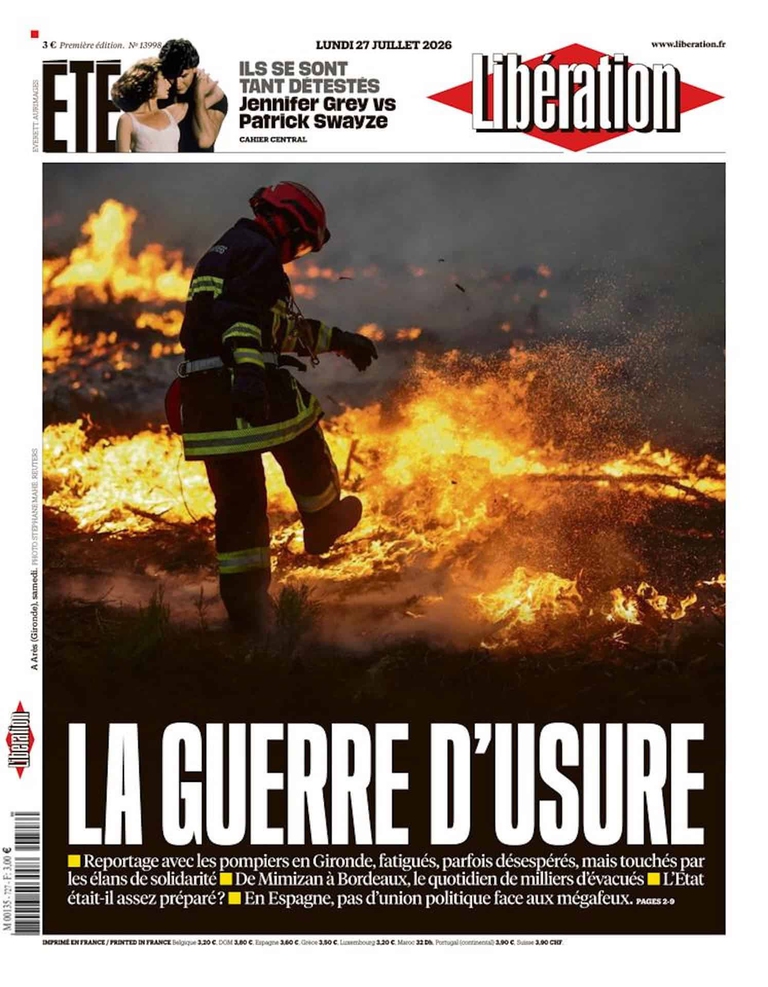
“A monster”, “the apocalypse”, “something never seen before”. The French press is struggling to find the words to describe what has been unfolding since last Wednesday in the Gironde department, in the Nouvelle-Aquitaine region of southwestern France. One of the worst wildfires in the country’s history, enormous in scale and still out of control, broke out in the municipality of Saumos, fuelled by exceptionally favourable weather conditions: weeks of extreme heat, a complete lack of rainfall, parched soils and dry vegetation.
🔴 Un incendie exceptionnel que la France n’a jamais connu.
Objectifs pour les forces de secours : préserver les vies humaines, protéger les biens et notamment les sites sensibles.
Le directeur du service d’incendie et de secours de Gironde décrit la stratégie actuellement… pic.twitter.com/QqNdroMMmR
— Préfète de la Nouvelle-Aquitaine et de la Gironde (@PrefAquitaine33) July 26, 2026
42,000 hectares burned, 220,000 people evacuated, 240 homes destroyed, 2,500 firefighters deployed
The perfect fuel for an explosive situation at the first spark. Strong winds in recent days further intensified the blaze. The outcome, according to figures released by the French authorities, has been catastrophic: 42,000 hectares of forest and vegetation have already been destroyed. More than 2,500 firefighters, 1,500 soldiers and 1,200 police officers and gendarmes, supported by hundreds of ground and aerial vehicles, have been deployed. Eighty-four firefighters have been injured, while 240 homes have been destroyed, 170 of them in the municipality of Le Porge.
At the same time, 220,000 residents have been ordered to evacuate—roughly the population of the Italian city of Padua. Although authorities insist that the issue is “not currently on the agenda”, they have even considered the possible evacuation of Bordeaux, as the flames have reached within 15 kilometres of the city, home to around 267,000 people.
Pyrocumulonimbus clouds are generating thunderstorms that feed the fire
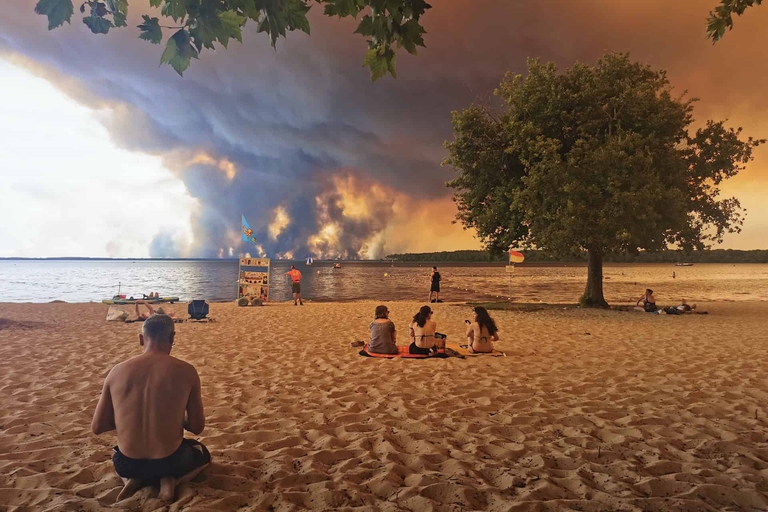
The wildfire has become so intense that it has generated pyrocumulonimbus clouds—towering clouds created by smoke and the extreme heat of the flames that can become so large and dense they produce genuine thunderstorms. “We have recorded several episodes of this incredible phenomenon, something unprecedented and previously unknown to us,” said Sophie Brocas, prefect of the Gironde department. “It is unpredictable, producing lightning that ignites new fires, as well as stronger winds that further fuel the blaze. And all this is happening in a department that contains one of Europe’s largest forests, meaning an enormous supply of fuel.”
These so-called “fire thunderstorms” make the behaviour of the wildfire even more unpredictable and firefighting operations even more difficult. “It is a miracle that no one has died,” said Jean-Baptiste Filippi, a researcher at the University of Corsica’s environmental sciences laboratory, speaking to Le Monde.
A rare “fire cloud” has formed in Bordeaux as wildfires continue to ravage France forcing British tourists to flee.
“What we are witnessing is truly exceptional: a cloud this massive and this high above a wildfire is extremely rare.” For comparison, the Pedrógão Grande wildfire in Portugal in 2017, which killed 60 people, generated two pyrocumulonimbus clouds. In Gironde, eight have already been recorded.
Reinforcements are limited because northern France is also at high wildfire risk
As firefighters struggle to contain the blaze, local communities have stepped in to help. Hundreds of farmers are using tractors and other machinery under the direction of firefighters across the many fire fronts, while thousands of residents are delivering food and water wherever possible.
With little time to rest, firefighters are sleeping in trucks or on the ground beside vehicle tyres for just a few hours before returning to the front line. “We try to get three or four hours of sleep to recover, but our bodies are starting to suffer. Some colleagues are really struggling,” one firefighter told France Info. Another was even more direct: “We’re exhausted, but above all we’re powerless. Completely powerless. We need more people. We’re doing everything we can, but it’s incredibly difficult.” Unlike in previous years, however, it has become much harder to redeploy firefighters and equipment from elsewhere in the country.
Eric Brocardi, spokesperson for the National Federation of Firefighters, acknowledged the operational difficulties. “Today, crews in northern France cannot be redeployed as they have been in the past, because wildfire risk is now high there as well.” He added a broader warning: “Our fear is that by September everyone will have forgotten about this.”
France has, in fact, been battling dozens of wildfires for weeks. Since the beginning of the year, 115,000 hectares have burned, and Interior Minister Laurent Nuñez said that 30 to 40 new fires are breaking out every day across the country.
In the areas affected by the Gironde megafire, the air has become almost unbreathable. Regional air quality agency Atmo has issued a red alert across six departments after PM10 concentrations exceeded safety thresholds. As a result, Prefect Brocas has urged tourists to choose other destinations and avoid the area despite the peak holiday season.
Firefighters are battling enormous wildfires tearing through forests in France and Spain, as authorities warn of a new heatwave set to engulf the scorched French wine-growing region around the city of Bordeaux.
Meteorologists are also warning of a fourth extreme heatwave since May, expected to hit southwestern France from Tuesday onwards, with temperatures once again approaching 40°C and very dry winds—conditions that represent the worst possible scenario for firefighters already battling the flames.
Three megafires threaten to merge near Madrid. Sánchez calls for a national climate pact
Three additional megafires are burning in the Madrid region of Spain. More than 90,000 people have been evacuated and 45,000 hectares have burned west of the capital. Local authorities warn that at least two, and possibly all three, fires could merge into a single massive wildfire, making suppression even more difficult.
🚒 En este momento, 50 medios terrestres y 12 aéreos, con más de 400 profesionales, están trabajando en el dispositivo por el incendio que afecta a la @ComunidadMadrid.
— 112 Comunidad de Madrid (@112cmadrid) July 25, 2026
Spain has also experienced repeated extreme heatwaves in recent months. On 26 July, the national meteorological agency confirmed that the first seven months of the year had been the hottest on record, a direct consequence of global warming. Prime Minister Pedro Sánchez once again called for “a great national pact in the face of the climate emergency”, arguing that the fight against rising global temperatures must become a shared national effort across the political spectrum.
Wildfires also burn in Scotland, Morocco, Algeria and Tunisia
While France and Spain remain Europe’s main wildfire hotspots, several other countries are also battling significant fires.
In Scotland, a major wildfire has broken out in the Cairngorms National Park. Around 650 residents of Nethy Bridge were evacuated for two days before being allowed to return home. More than 500 firefighters and helicopters have been deployed to tackle the blaze, which has already burned around 600 hectares.
Police declare 'major incident' over Cairngorms wildfire
— BBC Scotland News (@BBCScotlandNews) July 25, 2026
In Algeria, 17,000 hectares have burned since 8 July, when an extreme heatwave pushed temperatures close to 50°C in some areas. Authorities have recorded 1,850 fire outbreaks, and at least six people have died.
Between 20 and 22 July, around 900 wildfires also broke out in Tunisia. Although most have now been extinguished, two major fires remain active. Between 1 May and 23 July, 4,400 hectares burned across the country.
In Morocco, 310 wildfires have destroyed a further 1,850 hectares
Smoke and flames from a wildfire in the Bordj Okhriss area of northern Algeria's Bouira province rose as firefighters and volunteers worked to contain the blaze pic.twitter.com/WHm6bt0Jru
Wildfires spread across southern Italy; firefighter dies in Sicily
Italy has also experienced several major wildfires. One of the most significant is burning near Peschici, in Gargano National Park, where high temperatures and strong winds have allowed the flames to spread rapidly through Mediterranean scrub and Aleppo pine forests. Campgrounds have been evacuated, roads closed, railway services suspended and several beaches declared inaccessible. Some tourists have had to be rescued by sea.
According to the Italian news agency ANSA, the fire first spread through the rural area of Pile Fraballe before moving downhill towards the coast, from Difesa di Manaccora to Baia Zaiana.
Other wildfires have affected Molise, Calabria and Basilicata. Around 100 hectares have burned near Cirò Marina, almost 60 people have been evacuated near Maratea, and earlier fires in Sicily claimed the life of a firefighter who suffered a fatal medical emergency while on duty.
According to analysts, the emergence of a “super” El Niño could trigger a global food price shock, adding to inflationary pressures already fuelled by the conflict with Iran.
After a landslide led to twelve deaths on the island of Ischia, questions have been raised about the impacts of illegal building, tourism, and climate change.
Not much snow, peaks of 19 degrees Celsius in Norway and even 28 degrees in France: official data confirms the anomalously high temperatures of this past winter.
Ocean warming has risen to record highs over the last five years: just in 2019 the heat released into the world’s oceans was equivalent to that of 5-6 atomic bombs per second. The culprit, no doubt, is climate change.
What did Greta Thunberg tell participants at the 2020 World Economic Forum in Davos? Once again, the Swedish activist underlined the total lack of concrete solutions to the climate crisis presented by leaders so far.
The list of human and animal victims of the Australia wildfires keeps growing – one species might already have gone extinct – as the smoke even reaches South America.