



Pescasseroli, in the heart of Italy’s Apennines, will host the IBA conference on bear conservation and human–bear coexistence. LifeGate will be the event’s media partner.
Although Earth Overshoot Day falls six days later than in 2025, this does not represent an improvement. The shift is the result of revised estimates of the oceans’ carbon absorption capacity, while humanity’s actual ecological footprint continues to grow.
Il 30 luglio 2026 è l’Overshoot day, ovvero il giorno in cui, secondo il Global footprint network, l’umanità ha consumato l’intero budget annuale di risorse, come il legname nelle foreste e i pesci nel mare, e servizi ecologici, come l’assorbimento della CO2 e la capacità di produrre energia idroelettrica, che il Pianeta è in grado di generare in un anno.
Come ogni anno la data è stata annunciata il 5 giugno, in occasione della Giornata mondiale dell’ambiente. Rispetto al 2025 l’evento si è verificato più tardi di 6 giorni, ma questa non è necessariamente una buona notizia.
30 July 2026 marks Earth Overshoot Day, the date on which, according to the Global Footprint Network, humanity has consumed the entire annual budget of natural resources—such as timber from forests and fish stocks—and ecosystem services, including carbon dioxide absorption and hydropower generation, that the planet can regenerate in a single year.
As every year, the date was announced on 5 June, World Environment Day. Compared with 2025, Earth Overshoot Day falls six days later, but this is not necessarily a positive development.
Earth Overshoot Day marks the point at which humanity’s demand for natural resources exceeds what Earth’s ecosystems can regenerate within the same year. Until that date, we remain within the planet’s ecological limits; afterwards, we begin consuming “on credit”, drawing down the natural capital estimated for the following year. This ecological deficit is possible because we can temporarily overuse resources, but it comes at the cost of depleting ecosystems and accumulating waste—most notably carbon dioxide in the atmosphere.
The date is determined using a specific calculation. The Global Footprint Network, the international sustainability organisation that developed the ecological footprint concept, divides the Earth’s biocapacity—the amount of ecological resources the planet can generate in a given year—by humanity’s ecological footprint, then multiplies the result by the number of days in the year. Since 2026 has 365 days, the calculation places Earth Overshoot Day on 30 July. The estimates are based on the National Footprint and Biocapacity Accounts, governed by FoDaFo and maintained by York University.
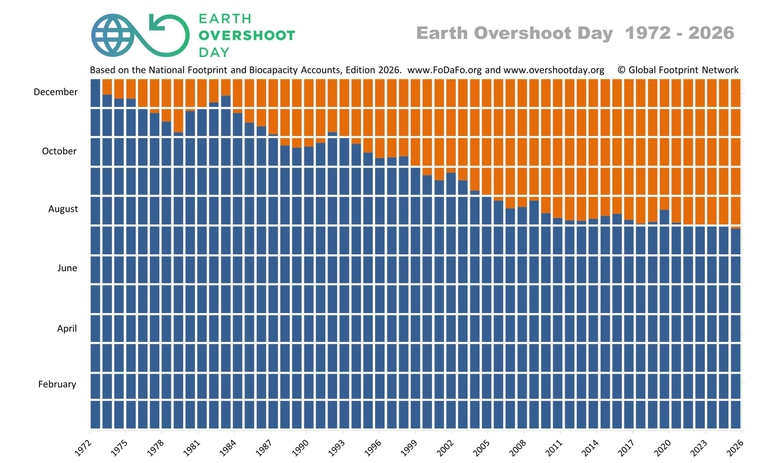
In 2026, Earth Overshoot Day falls six days later than it did in 2025. However, this does not represent genuine progress. In 2025, the date fell on 24 July, the earliest ever recorded.
This shift is almost entirely the result of a scientific update. The most significant revision this year was an upward correction of the ocean’s capacity to absorb carbon. Together with several smaller adjustments, this pushed the estimated Overshoot Day further into the year compared with the 2025 calculation. In other words, the change reflects updated data rather than a real reduction in ecological overshoot.
Despite the apparently later date, 2026 still represents the highest level of ecological overshoot ever recorded. Humanity is currently using nature 73 per cent faster than ecosystems can regenerate it, equivalent to consuming the resources of 1.73 Earths.
Ecological debt is cumulative, and every year of overshoot adds to those before it. Since ecological overshoot began in the early 1970s, this growing debt has contributed to biodiversity loss, deforestation, soil degradation and rising greenhouse gas concentrations.
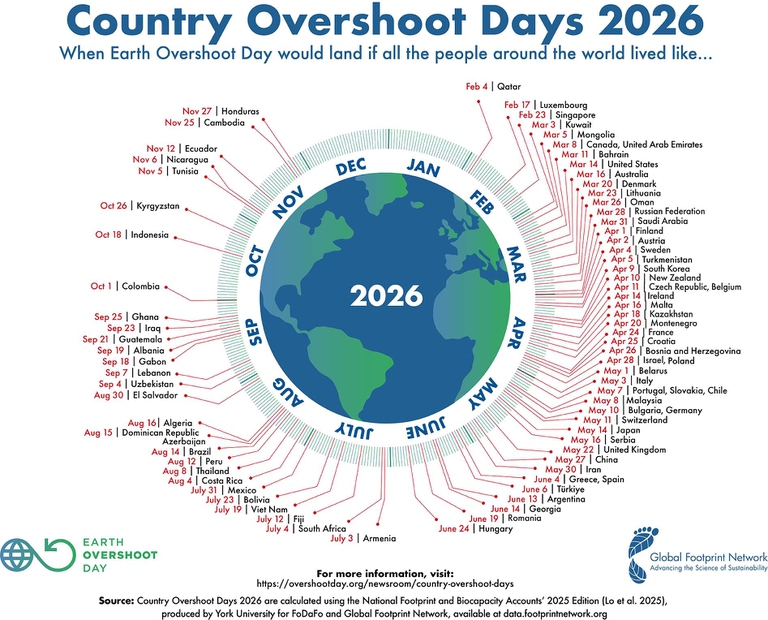
While 30 July is the global date, every country has its own Overshoot Day, calculated as if the entire world’s population lived according to that country’s consumption patterns. Countries with the largest ecological footprints exhaust their annual resource budget much earlier. For example, if everyone lived like the people of Qatar, Earth’s resources would be depleted by 4 February.
Italy ranks well ahead of the global average. In 2026, Italy’s Overshoot Day fell on 3 May, meaning that from that date onward the country has symbolically entered a state of ecological debt.
The Global Footprint Network is promoting the #MoveTheDate campaign, which aims to move Earth Overshoot Day progressively later in the calendar. Its Power of Possibility initiative brings together more than 100 solutions that are already available and economically viable across five key areas: cities, energy, food, population and the planet. According to the organisation’s estimates, cutting fossil fuel CO₂ emissions by 50 per cent would postpone Earth Overshoot Day by three months.
This year, the Global Footprint Network is also releasing a new report, Prepared for the Predictable?, which criticises governments for their lack of preparedness. According to the report, almost no national government treats resource security as a central element of its economic planning, even though ecological overshoot is driving stagflation, food and energy insecurity, health crises and conflict. As David Lin, one of the report’s authors and the organisation’s chief scientist, summarises, the countries that plan for a future of limited resources will be the ones best equipped to withstand its impacts—but very few are doing so today.
Siamo anche su WhatsApp. Segui il canale ufficiale LifeGate per restare aggiornata, aggiornato sulle ultime notizie e sulle nostre attività.

Quest'opera è distribuita con Licenza Creative Commons Attribuzione - Non commerciale - Non opere derivate 4.0 Internazionale.
Pescasseroli, in the heart of Italy’s Apennines, will host the IBA conference on bear conservation and human–bear coexistence. LifeGate will be the event’s media partner.
The inflation caused by extreme weather events is known as “climateflation”: prices for many food products are expected to rise sharply.
The toll is still provisional, but data collected across several European countries indicate that tens of thousands of people have died as a result of extreme heat.
Last February, Malaysia imposed a total ban on electronic waste imports. Yet toxic e-waste continues to arrive from the United States and other countries through illegal trafficking networks.
Gigantic wildfires in France’s Gironde region and near Madrid, Spain, have devastated tens of thousands of hectares of vegetation.
Greece has launched a wildfire management system based on nanosatellites and artificial intelligence. A model that other countries are now looking to replicate.
According to analysts, the emergence of a “super” El Niño could trigger a global food price shock, adding to inflationary pressures already fuelled by the conflict with Iran.
Residents of Kanseche, Malawi, accuse ABF of contributing to the devastating 2022 floods through its subsidiary, Illovo Sugar.
Ecuador’s shrimp exports continue to grow, but the country’s mangrove ecosystems are paying the highest price.


