




Pescasseroli, in the heart of Italy’s Apennines, will host the IBA conference on bear conservation and human–bear coexistence. LifeGate will be the event’s media partner.
Nature is one of the best allies against climate change, but we’ve been underestimating its role. The Nature Conservancy’s latest study demonstrates why natural climate solutions can’t be overlooked.
The last two years have seen significant global advancement on climate action, with hundreds of global businesses and national and sub-national leaders building on the momentum of the Paris Agreement to initiate new climate pledges, initiatives and funding programmes. But there remains a gap between promised action and realised climate progress, and many solutions available to us now remain underutilised – especially in the land sector, which currently accounts for nearly a quarter of greenhouse gas emissions.
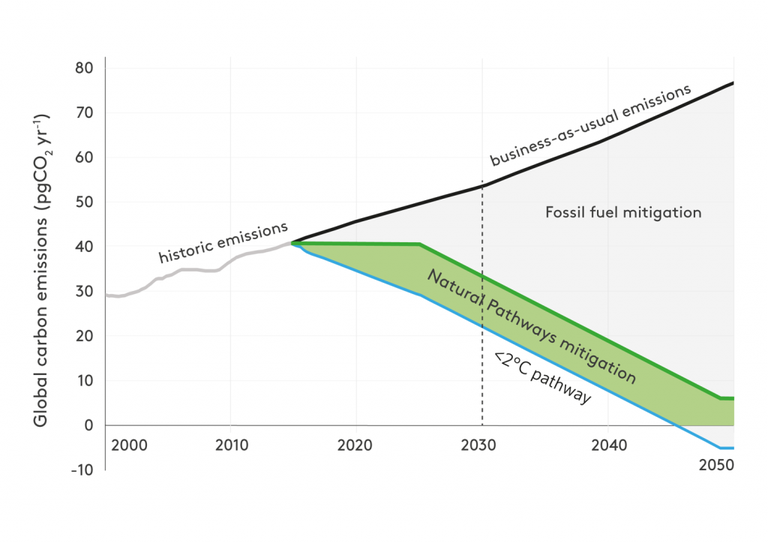
In fact, new research shows that stewardship of the land can play a significant role in keeping global temperature increases under 2 degrees. The Nature Conservancy partnered with the Doris Duke Charitable Foundation to bring together more than two-dozen expert scientists specialising in conservation, climate modelling, and economists from a variety of global institutions to explore this issue. They found that nature’s ability to mitigate climate change is about 30 per cent higher than previously projected.
Read more: What is climate change
These results are described in “Natural climate solutions,” published in Proceedings of the National Academies of the Sciences. The paper shows that with concerted global action between now and 2030, better land stewardship offers 37 per cent of the solution for keeping global temperatures to 2 degrees or below – the same as if the world today put a complete stop on the burning of oil. In addition, the paper’s economic analyses show that natural climate solutions – the proven ways of storing and reducing carbon emissions in forests, grasslands and wetlands – can provide low-cost opportunities and are often significantly more cost effective when compared to technological solutions.
The world risks losing these opportunities, however, if we continue with a business-as-usual approach. Increased emissions entering the atmosphere coupled with continued environmental degradation will lessen the impact that nature can have. If natural climate solutions are mobilized over the next 10 to 15 years and coupled with reduction in fossil fuel emissions, they could provide 37 per cent of the needed mitigation for global climate targets. But if action is delayed until after 2030 that number drops to 33 per cent and drops again to only 22 per cent after 2050.
Right now, variations of land-based climate solutions appear in more than 75 per cent of individual country commitments to the Paris Agreement, yet renewable energy, energy efficiency and clean transport together receive nearly 30 times the amount of public mitigation investment that land-based solutions receive. Of the funding that is set aside for natural climate solutions, the vast majority tends to focus on tropical forest protection in developing countries. But this study shows that a variety of natural climate solutions – including those in grassland, agricultural and wetland ecosystems – are relevant across the globe and can have a large impact on almost any country’s emissions. Furthermore, these solutions bring added social and environmental benefits, such as cleaner air and water, sustainable food production and increased habitat.
Climate change is the largest and most complex environmental crisis we have ever seen. Mobilising natural climate solutions doesn’t mean that we should cut back on the research and development of renewables, electric cars, energy efficiency methods. Nor is action on natural climate solutions a substitute for ceasing to burn fossil fuels. Rather, in addition to low-carbon measures, they’re the only realistic way to achieve sufficient emissions reductions to defeat climate change. While looking forward, we can’t lose sight of one of the most important solutions – just under our feet.
Siamo anche su WhatsApp. Segui il canale ufficiale LifeGate per restare aggiornata, aggiornato sulle ultime notizie e sulle nostre attività.

Quest'opera è distribuita con Licenza Creative Commons Attribuzione - Non commerciale - Non opere derivate 4.0 Internazionale.
Pescasseroli, in the heart of Italy’s Apennines, will host the IBA conference on bear conservation and human–bear coexistence. LifeGate will be the event’s media partner.
The inflation caused by extreme weather events is known as “climateflation”: prices for many food products are expected to rise sharply.
The toll is still provisional, but data collected across several European countries indicate that tens of thousands of people have died as a result of extreme heat.
Last February, Malaysia imposed a total ban on electronic waste imports. Yet toxic e-waste continues to arrive from the United States and other countries through illegal trafficking networks.
Although Earth Overshoot Day falls six days later than in 2025, this does not represent an improvement. The shift is the result of revised estimates of the oceans’ carbon absorption capacity, while humanity’s actual ecological footprint continues to grow.
Gigantic wildfires in France’s Gironde region and near Madrid, Spain, have devastated tens of thousands of hectares of vegetation.
Greece has launched a wildfire management system based on nanosatellites and artificial intelligence. A model that other countries are now looking to replicate.
According to analysts, the emergence of a “super” El Niño could trigger a global food price shock, adding to inflationary pressures already fuelled by the conflict with Iran.
Residents of Kanseche, Malawi, accuse ABF of contributing to the devastating 2022 floods through its subsidiary, Illovo Sugar.


