In the heart of the United Kingdom, there is a production site that has become the European laboratory of a virtuous idea: turning end-of-life vehicles into resources for the future.
End-of-life vehicles regain value thanks to the implementation of circular economy processes.
With the first Circular Factory in Burnaston, UK, Toyota aims to be a virtuous example of transforming its business model.
Toyota’s pilot project makes it possible to measure and improve the circularity index in the automotive industry.
In doing so, Toyota is putting into practice production processes that could shape future circularity models across Europe.
Today, the car sits at the centre of the main challenges facing the industry, linked to the ecological transition and sustainable economic development. The circular economy is emerging as a key paradigm for rethinking the entire automotive sector, integrating public policies, infrastructure, industry and services into a systemic vision capable of generating economic, environmental and social value. In this context, production sites play a key role and become not only places of experimentation and innovation, but also drivers of attractiveness for investment, research and innovation.
The goal? To show how a circular approach can strengthen competitiveness and support the sustainable growth of the automotive industry. A transformation that is certainly complex, involving the car in its entirety: from the production processes of each individual component to increasingly circular biobased materials, where remanufacturing, disassemblability, recoverability and regeneration become the new watchwords of future mobility.
Old cars, new purpose: what lies at the heart of the Toyota project
There is a concrete, European, “courageous” example we want to tell you about. A car factory that for over a century operated according to a simple, linear logic: raw materials go in, new vehicles come out. End of the story. What happened to vehicles after years of use was, at best, someone else’s problem. Today, at Toyota’s plant in Burnaston, Derbyshire, that logic is being overturned with method, precision and a strong industrial vision.
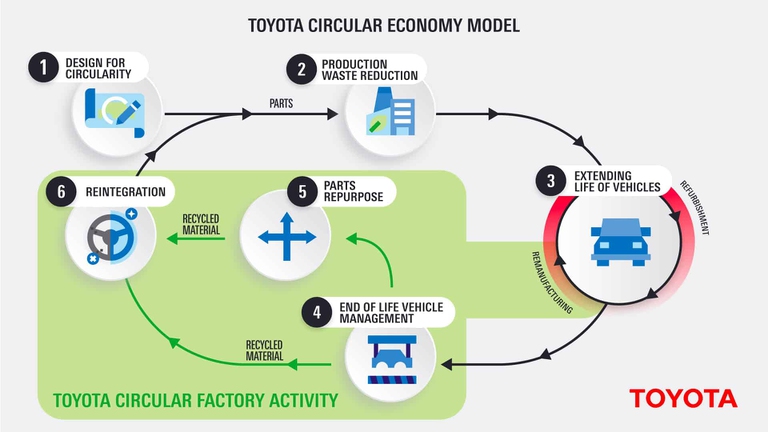
It is here that the circular factory has taken shape, the first in Europe, a pilot project addressing one of the most concrete challenges in the automotive industry: what to do with cars when they reach the end of their life. At its core is the circular principle according to which an old car destined for scrapping can be reborn into a new life. In other words, circularity as a lever to reduce emissions — well beyond the concept of exhaust gases — and to strengthen the resilience of materials along the mobility value chain.
It is not enough to dismantle. You have to rethink backwards
The idea behind the project is not new in principle — recovering parts and materials from end-of-life vehicles has existed for decades and has been widely studied — but it is new in its method. Toyota has taken the same logic applied to the organisational model that revolutionised global manufacturing efficiency and applied it in reverse: not to assemble, but to disassemble in the most efficient way possible. And not only Toyota vehicles, but also those of other automotive brands.
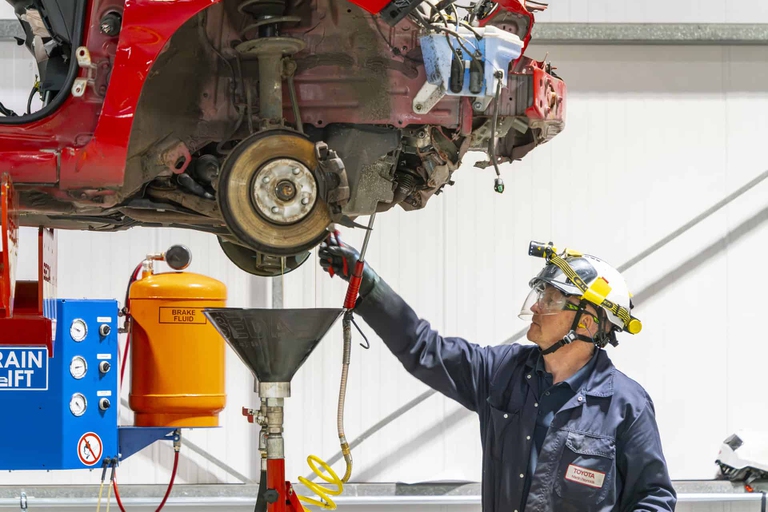
The process is structured, almost surgical, although still in its early stages; a department within a department where a small group of workers who once worked on production lines now focus on restoring value to what many consider waste. Let us explain. Used or damaged vehicles arriving at the Toyota circular factory in Burnaston are first made safe: batteries, glass and airbags are removed, and all fluids (oils and any fuels) are extracted through monitored and certified procedures. Then begins a slow and meticulous dismantling phase that, in a way, takes the highly modern and largely robotised assembly line activities back to a process that has something artisanal about it, requiring laborious manual classification of materials: metals, plastics, mixed components, each directed towards a specific destination.
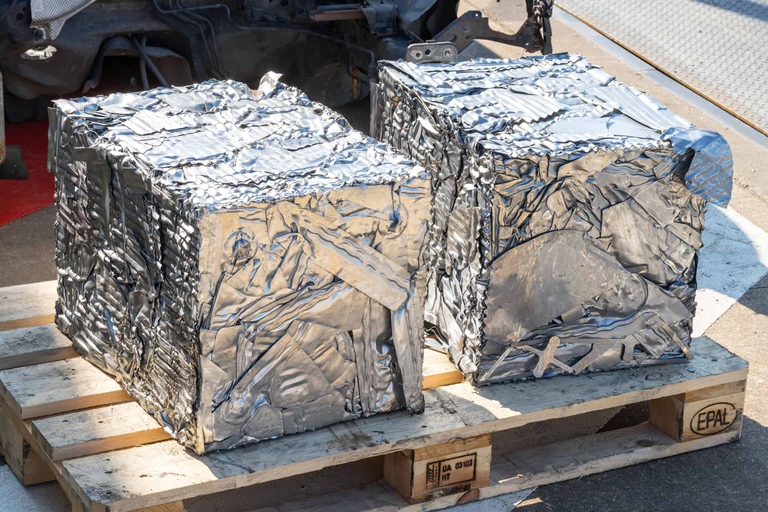
The most tangible result of this approach? Aluminium recovered from car wheel rims is melted down and transformed into new engine blocks at Toyota’s Deeside plant in North Wales, before returning to the assembly lines of the same system from which the process began. A loop that closes physically, not just on paper.
And it is not only Toyota or Lexus vehicles, as mentioned. These modern facilities process models from different brands, greatly expanding the value of the data collected: material behaviour, component durability, ease or difficulty of access during dismantling. Everything is documented and passed on to the engineers designing Toyota’s future vehicles, with a clear objective: to build cars designed to be dismantled — indeed disassembled. The concept of “design for circularity”, which, as we have seen firsthand during the complex and meticulous dismantling operations, is still far from being fully achieved.
Why a pilot project in the United Kingdom?
The choice of Burnaston as the location of the first European Toyota circular factory is not accidental. The United Kingdom is one of the largest markets in Europe for end-of-life vehicles, and its specific feature (left-hand driving) means that almost all cars sold in the country remain within its borders until the end of their life, ensuring a stable and predictable flow of materials.
“We initially plan to recycle around 10,000 vehicles per year at our UK facility, giving new life to 120,000 parts, recovering 300 tonnes of high-purity plastic and 8,200 tonnes of steel, as well as other materials,” explained Leon van der Merwe, Vice President of Circular Economy at Toyota Motor Europe.
Extending life before the end of life
But automotive circularity has many facets. Alongside dismantling activities, the Toyota circular factory also hosts a refurbishment unit: in this case, used vehicles (only Toyota and Lexus models) that are no longer in perfect condition but may require only minor interventions to return to the market are assessed, classified, restored and validated according to strict Toyota standards — effectively ensuring that recent used cars meet the same quality criteria applied to new vehicle production. Another virtuous example of extending a car’s life cycle.
The Burnaston automotive circular economy pilot project has been operational since August 2025 and has already generated encouraging results in its first year. So much so that Toyota has already announced a second circular factory in Poland, at the Wałbrzych plant, scheduled to open in 2026: the next node in what aims to become a European network of industrial circular economy.
The road towards circularity in the automotive industry is still long, there is no doubt. For this reason, Toyota’s stated ambition goes beyond its own corporate boundaries. The knowledge developed in Burnaston — on processes, safety and materials — is intended to be shared with the brand’s entire industrial ecosystem, contributing on the one hand to a transition towards more effective end-of-life vehicle management, and on the other to achieving the goals of the Environmental Challenge 2050, which includes “creating a recycling-based society.”
Playing with the concept of Still Life, the campaign shot by photographer Roberto Savio depicts Stellantis’ vision of the circular economy, a holistic approach to product sustainability that extends throughout the entire life cycle of the car.
Wood is renewable, recyclable, climate friendly and incredibly versatile. A journey into how this material can help shape a more healthy global economy.
The European Green Deal launched by Ursula von der Leyen’s Commission is a colossal transformation that involves the economy, industry and society. Faced with this challenge, citizens are proving to be responsive and proactive.
From fashion to design, from architecture to construction, biomaterials and their applications are constantly multiplying. And designers are responding to this revolution in many different ways.
You have time until 7 November to enroll. ClimAlt online lessons are completely free and are aimed at young people living in the European Union who care about climate change.
Mountain areas are home to around 1 billion people and provide goods and services. This is why the protection of healthy mountain ecosystems has become a must. The op-ed by FAO’s Mountain Partnership Secretariat.