



The measure is part of the new EU Ecodesign Regulation, which came into force on 19 July and requires greater transparency and better inventory management from companies.
Playing with the concept of Still Life, the campaign shot by photographer Roberto Savio depicts Stellantis’ vision of the circular economy, a holistic approach to product sustainability that extends throughout the entire life cycle of the car.
In an era when the environment is holding us accountable for our choices, the automotive industry is rewriting the rules of the game. Designing and building a car is a complex task, even more so if that car, or its parts, are meant to be given a second chance. If the process is to be integrated into the circular economy, a system whose core principle is the prefix “re”: remanufacturing, repair, reuse, recycle. Throughout the history of the automobile, research into materials has always been a constant. Today, in addition to traditional goals like lightness and robustness, new criteria are decisively steering innovation: sustainability in the use of resources, consumption reduction, durability, recyclability, and renewability.
By alternating trend analysis with case studies, this was already clearly explained back in 2018 in the volume Neomaterials in the Circular Economy – Automotive. The aim of the book was to guide the reader through the complex layers of a radical revolution, positioning itself—as stated in the preface by Roberto Giolito (a designer who shaped Italian automotive history with models like the Fiat Multipla and the current Fiat 500, and now Head of heritage at Stellantis) – as “a toolkit of operational instruments for those tackling the design of the automobile in its broadest sense.”
2018-2025: in just a few years, the automotive world has undergone a radical transformation. Any hesitation surrounding the technological shifts that will enable the sector to complete its ecological transition seems to have vanished. Concepts like regeneration, deconstructability, recoverability, and recyclability are becoming increasingly significant.
To truly understand the complex and delicate transformation the automotive industry is undergoing, to see the future of a product that stands as a symbol of human creativity, we need the ability to uncover what lies beneath the surface of car interiors, where comfort is increasingly tied to the durability and reparability of materials. We must understand what durability and renewability of materials really do mean.
This is not an easy or painless transformation. But one thing is certain: nature teaches us its paradigm based on circularity, and business is now adopting those principles for an economy that can no longer ignore sustainability. Research into new materials will support us—because new performance standards are needed. Strength that goes hand in hand with sustainability. A use of resources that reduces consumption and increases durability. Recyclability and renewability will increasingly become integral parts of our cars.
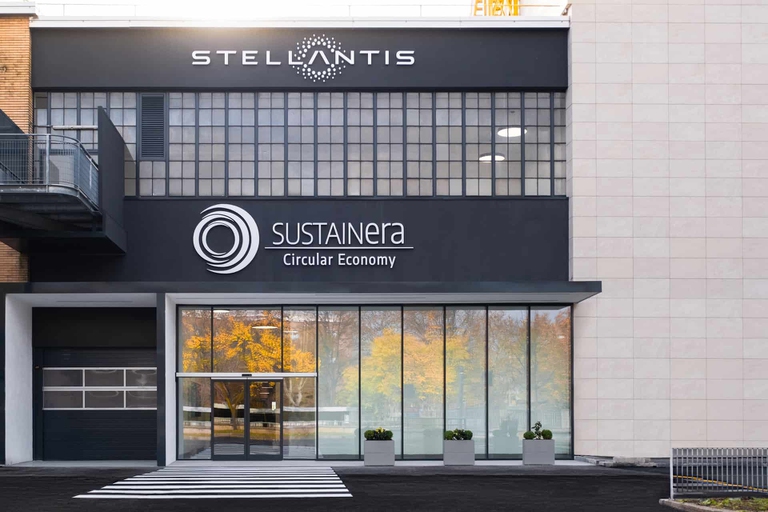
This is the new face of the automobile—the invisible force transforming the way we think, develop and act. A concept Stellantis understood well when it launched SUSTAINERA in 2022, a business unit entirely dedicated to circular economy activities. In 2023, it inaugurated the first SUSTAINERA Circular economy hub: a 73,000-square-meter facility born from the conversion of an existing structure within the Mirafiori complex in Turin—described by John Elkann, Chairman of Stellantis, as “a model automotive plant that combines environmental respect with economic development.”
This facility now hosts operations such as the remanufacturing of engines, gearboxes, and batteries for electric vehicles, as well as the reconditioning and dismantling of vehicles, where used, worn, or defective components are disassembled, cleaned, and remanufactured without compromising quality—or otherwise reused or recycled. These components, and even entire vehicles, are reintroduced to the market through dedicated sales and service channels, returning to new life.
SUSTAINERA, Stellantis’ initiative, aims to:
At the heart of this strategy are the 4Rs—Reman (remanufacturing), Repair, Reuse, and Recycle, representing key actions for a more sustainable model of production and consumption. This marks a paradigm shift from the traditional linear “produce-use-dispose” model. This vision is directed not only at drivers but also at aftermarket professionals and maintenance operators, building an offering that aspires to be the responsible choice for all stakeholders in the value chain.
To better understand the value of the SUSTAINERA initiative, we need to take a step back. Because while it’s true that today the green transformation trend is touching every aspect of the automotive sector, much of that transformation, though long underway, remains invisible to the most. And what better way than art to tell the story, with fresh and creative eyes, of the most recent and fascinating developments in what remains one of the most extraordinary technologies ever developed by humankind?
Art has always had a unique ability to capture change—not only reflecting our sociocultural reality, but also encouraging greater awareness and inspiring real action. That’s why artists can play a key role in promoting the circular economy, creating works that spark reflection on environmental issues and inspire a cultural shift toward sustainability.
With this goal in mind, raising public awareness around these concept, SUSTAINERA commissioned still life photographer Roberto Savio to create the visual campaign Still Life. Still life, a photographic and artistic technique focused on depicting objects, was the perfect medium for illustrating, both tangibly and conceptually, each of the 4 R’s of the strategy. “The aim wasn’t just to describe, but to evoke emotion,”explained Savio, speaking from the set created at the SUSTAINERA Hub in Turin.
I chose a representation that was both concrete and conceptual, to visually convey the deeper meaning of the 4Rs.
Still Life does more than simply represent the four practices of the circular economy, it translates their principles into a visual language that is accessible and engaging, yet firmly rooted in precise technical realities. Each image encapsulates an industrial process currently underway in the remanufacturing, repair, reuse, and recycling centers, showing how ecological transition can take on forms that are understandable, communicable, and even aesthetic.
By playing on the double meaning of the phrase Still Life, referring both to the specific photographic technique used for the four images and to the idea that “there is still life”, Stellantis aims to convey that even what seems beyond recovery can still have a future, thanks to circular economy practices designed to extend the lifespan of components, materials, and vehicles. The SUSTAINERA philosophy proves that sustainability in the automotive sector is not just an environmental necessity, as we’ve already seen, but also a driver of industrial and cultural innovation, where even auto parts, when observed closely, can tell powerful stories of transformation, efficiency, and rebirth.
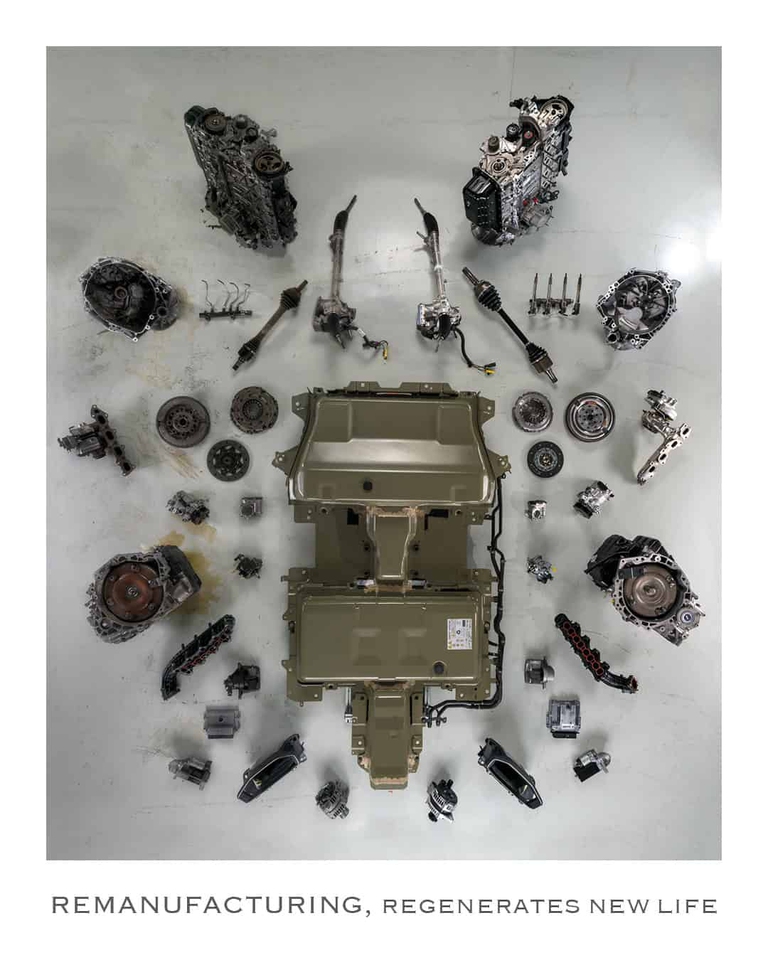
The first shot is dedicated to remanufacturing. Here, Roberto Savio adopted a technical and geometric approach using two visual techniques: knolling, which arranges objects with precision, and mirroring, which emphasizes symmetry. The goal? To show the contrast between the worn component and the remanufactured one. This visual representation illustrates the transformation process: on the left side, worn, dark, and dirty components; on the right side, their fully remanufactured counterparts, clean, shiny with chrome plating, and ready for a new life.
I wanted to show how worn mechanical parts can shine again instead of being discarded.
The image reflects a concrete industrial practice: through remanufacturing, restoring components to OEM specifications (Original equipment manufacturer, referring here to the vehicle maker), a recovered part can function with the same performance and warranty as a new one, bringing economic and environmental benefits.
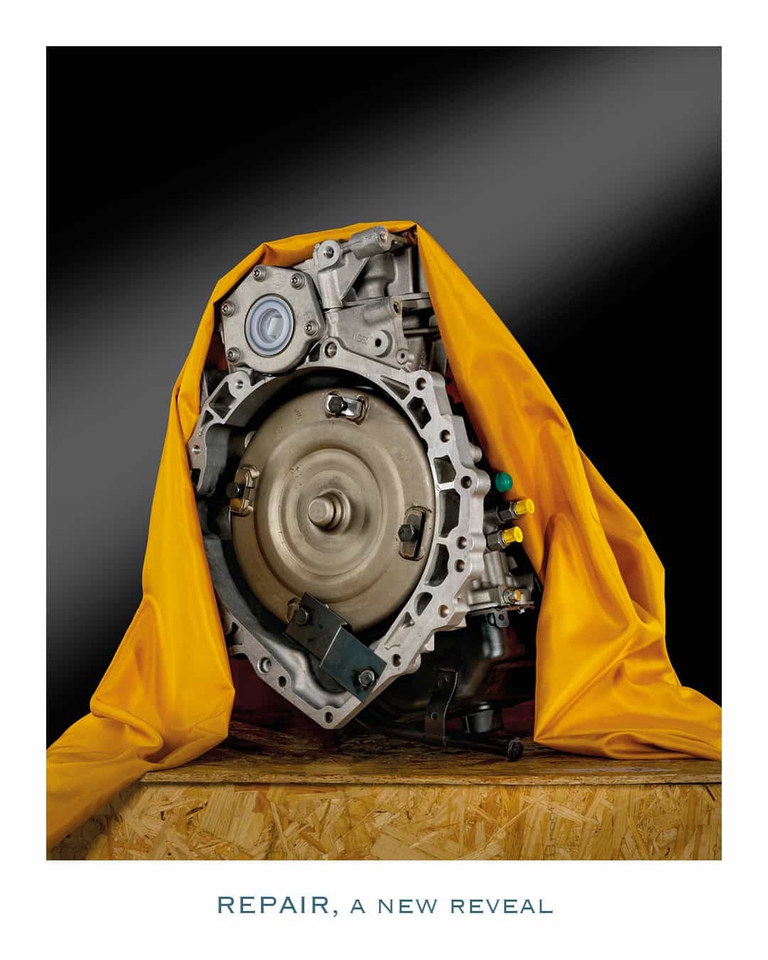
The second image represents repair as a return to the spotlight. At the center of the composition is a repaired automatic gearbox, framed by a golden drape inspired by Renaissance portraiture iconography. The mechanical component is not treated merely as a functional object but is elevated to a symbol. “I wanted to evoke the idea of a return to the stage, like a component that comes back to life,” Savio explains.
The artwork highlights how repair is both a technical practice and an act of reclaiming value. It involves care, precision, and a vision of what can still be useful. It is a tribute to sustainability and innovation. Every repaired component carries with it a story of time and respect for materials that still have much to offer—deserving a second chance, a new reveal indeed.
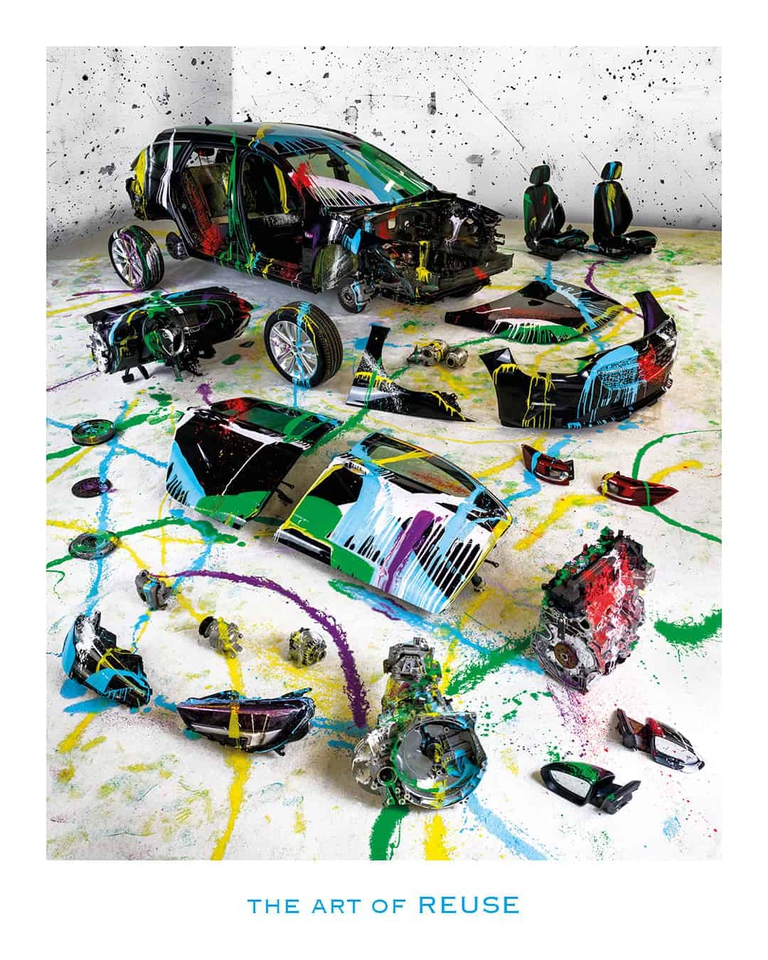
For the R of reuse, Savio chose to explore the artistic dimension of recovery: inspired by action painting, an end-of-life car was dismantled, and its components were arranged on a surface and treated like canvases, painted with bold and expressive eco-friendly colors. This represents a piece of automotive pop art, a symbol of the art of reusing components that are 100% functional, recovered and repurposed in other vehicles.
Here, reuse is conceived not only as an extension of an object’s lifespan but also as a perceptual transformation: an invitation to look at end-of-life vehicle parts with new eyes, not as waste, but as components that can indeed have a second life as used spare parts. All of this is told through a technique where “color transforms the visual impact of an end-of-life car, evoking new and positive emotions,” as Savio emphasizes.
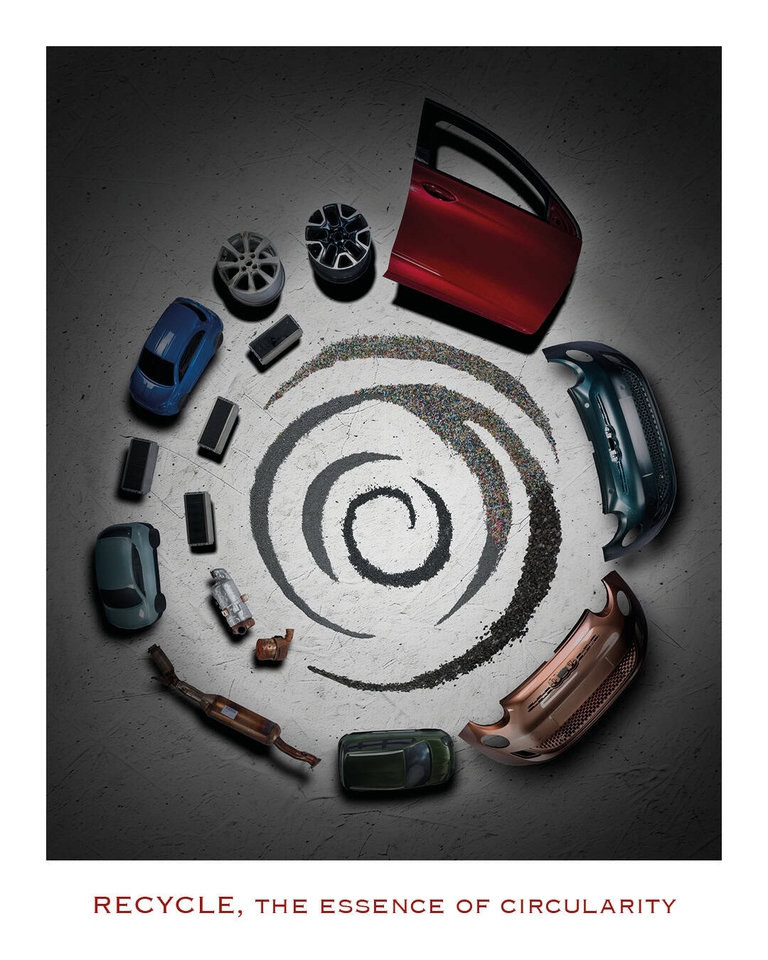
In the fourth and final shot, Roberto Savio addresses the theme of recycling through the creation of a spiral composition inspired by the SUSTAINERA logo, the golden ratio, and Land Art. The components arranged in a spiral evoke the concept of a continuous cycle typical of recycling, in harmony with the essence of circularity, where every end is a new beginning.
The photograph visually conveys the idea of a potentially infinite process where materials and resources are not depleted but transformed and preserved, minimizing waste. Their possibilities do not end but re-enter a new production cycle, being recovered and reinvented repeatedly, from vehicle to vehicle, contributing to a more sustainable system which endures over time.
Siamo anche su WhatsApp. Segui il canale ufficiale LifeGate per restare aggiornata, aggiornato sulle ultime notizie e sulle nostre attività.

Quest'opera è distribuita con Licenza Creative Commons Attribuzione - Non commerciale - Non opere derivate 4.0 Internazionale.
The measure is part of the new EU Ecodesign Regulation, which came into force on 19 July and requires greater transparency and better inventory management from companies.
Italy will become the first European country to host a facility for recovering rare earth elements: it will be built in Ceccano, central Italy.
Fat Lama wants to revolutionise the way people consume. The site will allow users to share their objects, combining trust and sustainability.
Net-zero emissions by 2030, zero wastage, and zero waste to landfill. The domestic appliances giant explains how it intends to reach its ambitious sustainability goals.
The pandemic has hit Europe hard, but it won’t put a stop to the Green Deal. In fact, the green transition is the key to relaunching the EU economy.
Whirlpool, t2i and the National Technical University of Athens (NTUA) present the Life MATHER project’s results during a digital event on Wednesday 9 December.
Over 90% of Gaza’s groundwater isn’t safe to drink. Mosab al-Hindi is fighting against huge odds to preserve water resources there.
The European Green Deal provides a set of concepts, tools and goals to support Italy’s sustainable transition – all the more vital post-pandemic.
The European Green Deal launched by Ursula von der Leyen’s Commission is a colossal transformation that involves the economy, industry and society. Faced with this challenge, citizens are proving to be responsive and proactive.


