


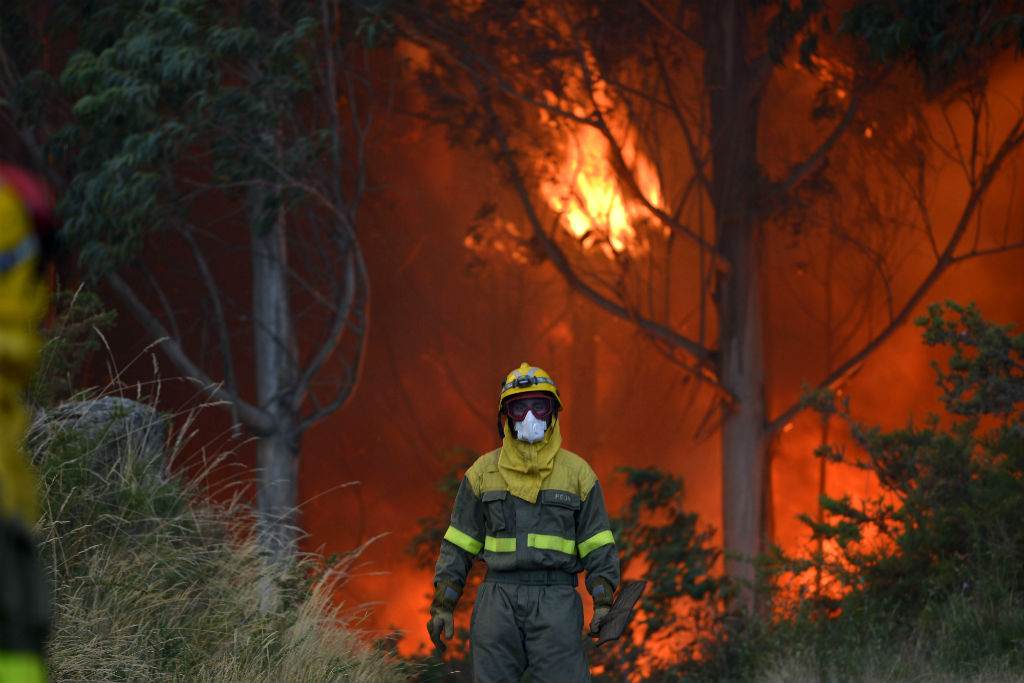

Gigantic wildfires in France’s Gironde region and near Madrid, Spain, have devastated tens of thousands of hectares of vegetation.
NASA’s analysis confirms the latest trends. August 2016 sets a new monthly record in high temperatures, continuing a streak of 11 consecutive months.
Scientists at the Goddard Institute for Space Studies (GISS) of New York have published their latest analysis on average global temperatures recorded in the month of August. And they show clear agreement in the overall warming trend: August is the hottest month in 136 years of modern record-keeping.
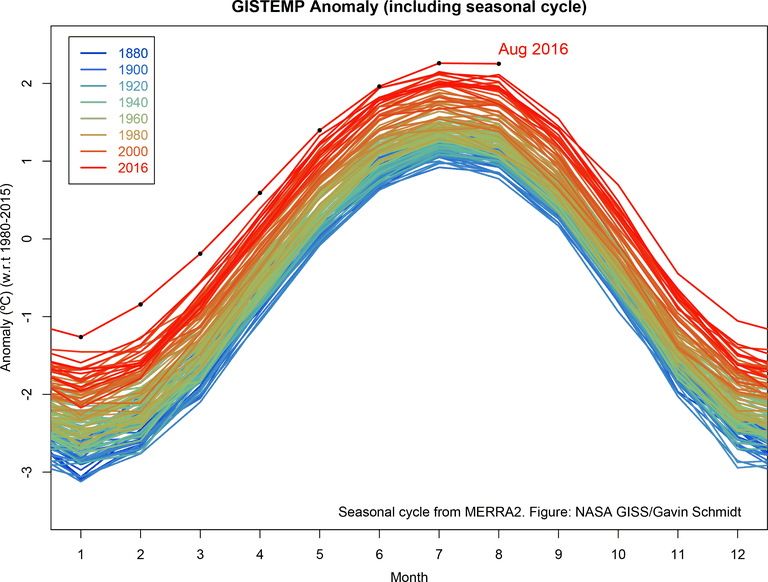
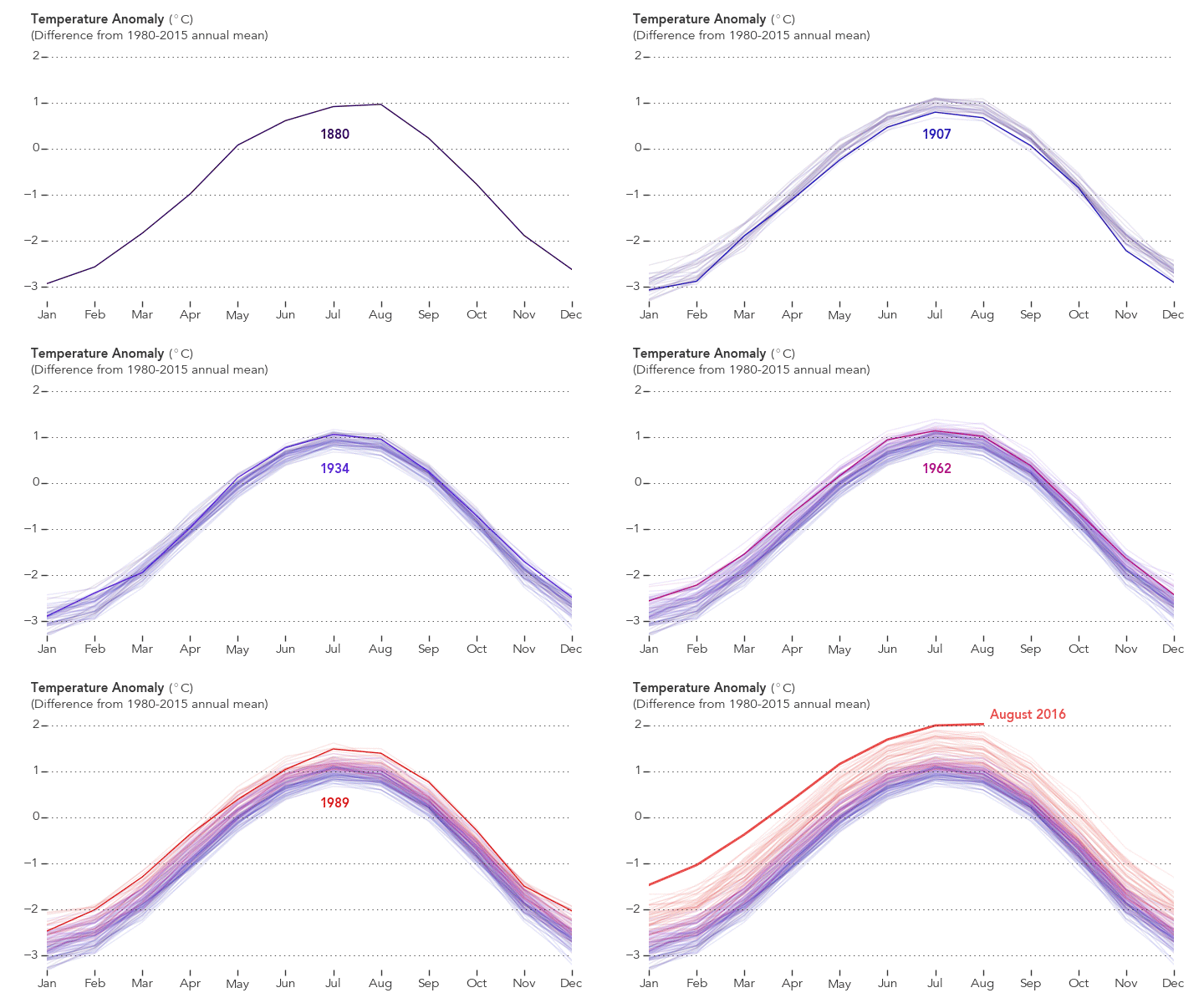
The graph above shows it well. The blue bends are the temperatures recorded in the last years of the nineteenth century, the green ones are the average temperatures recorded from the ‘40s and ‘60s to today, during the economic boom occurred after the end of World War II. But let’s focus on the red lines. Firstly, because they represent a shorter time span than the other bends (the last 16 years). Secondly, because August 2016 shows a very high average temperature and separates from the other lines. It was as many as 2°C warmer than the previous months.
Although the seasonal temperature cycle typically peaks in July, this year scientists have drawn their attention to the month of August. “Monthly rankings, which vary by only a few hundredths of a degree, are inherently fragile”, GISS Director Gavin Schmidt explained. “We stress that the long-term trends are the most important for understanding the ongoing changes that are affecting our planet”.
The fact remains that, August continued a streak of 11 consecutive months that have set high-temperature records. Since October 2015, data acquired by about 6,300 meteorological stations, ship and buoy-based instruments measuring sea surface temperature, and Antarctic research stations confirm the trends.
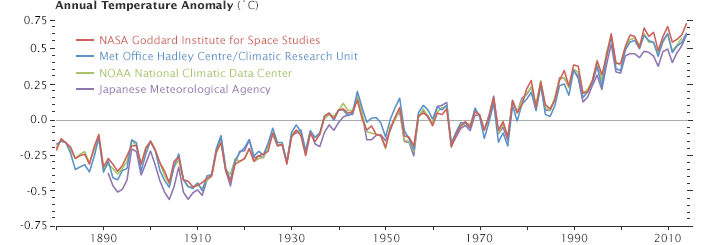
Scientists at NOAA, the British Met Office and the Japanese Metereological Agency agree that the last years, in particular 2014, 2015 and 2016, are the warmest months ever recorded. And they’ve confirmed it independently, providing different measurements that have the same result. The planet’s temperatures are increasing, relentlessly.
Siamo anche su WhatsApp. Segui il canale ufficiale LifeGate per restare aggiornata, aggiornato sulle ultime notizie e sulle nostre attività.

Quest'opera è distribuita con Licenza Creative Commons Attribuzione - Non commerciale - Non opere derivate 4.0 Internazionale.
Gigantic wildfires in France’s Gironde region and near Madrid, Spain, have devastated tens of thousands of hectares of vegetation.
According to analysts, the emergence of a “super” El Niño could trigger a global food price shock, adding to inflationary pressures already fuelled by the conflict with Iran.
Residents of Kanseche, Malawi, accuse ABF of contributing to the devastating 2022 floods through its subsidiary, Illovo Sugar.
France, Spain, Portugal and Greece are fighting wildfires, some of which are still out of control.
Much of Western Europe is already dealing with temperatures that in many cities are approaching or exceeding 35°C.
After a landslide led to twelve deaths on the island of Ischia, questions have been raised about the impacts of illegal building, tourism, and climate change.
Not much snow, peaks of 19 degrees Celsius in Norway and even 28 degrees in France: official data confirms the anomalously high temperatures of this past winter.
Ocean warming has risen to record highs over the last five years: just in 2019 the heat released into the world’s oceans was equivalent to that of 5-6 atomic bombs per second. The culprit, no doubt, is climate change.
What did Greta Thunberg tell participants at the 2020 World Economic Forum in Davos? Once again, the Swedish activist underlined the total lack of concrete solutions to the climate crisis presented by leaders so far.


