Italy’s new law on the enhancement of marine resources includes a general provision to protect a unique ecosystem, but for now it lacks concrete enforcement tools.
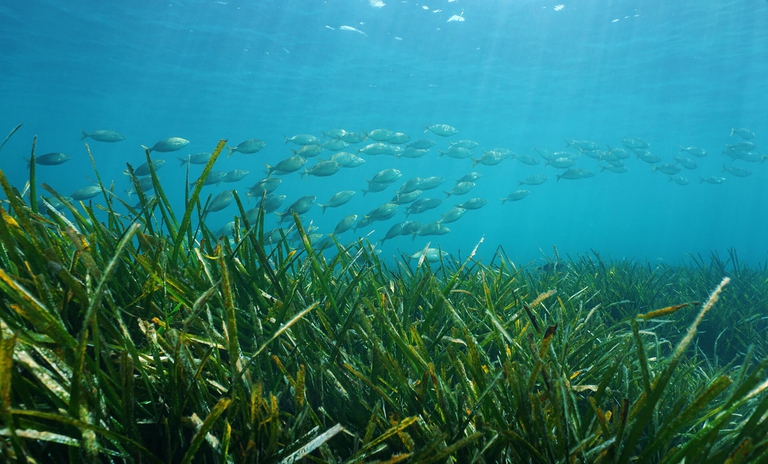
There are actual forests on the seabed, including in our own Mediterranean Sea, threatened by the passage — and even more by the anchoring — of every single vessel. These are the Posidonia oceanica meadows, and from today a new law, despite some limitations, attempts to protect what is in fact one of the richest and most valuable ecosystems on the planet.
Last week, the Italian Parliament approved the law on the Enhancement of Marine Resources, which covers many aspects of Italy’s maritime life, from governance of marine policies to recreational boating, from underwater recreational activities to shipbuilding. Among other things, however, it also includes environmental measures such as the protection of Posidonia oceanica meadows through anchorage management.
What the new “sea law” says about Posidonia
The law establishes a principle that until now had never been explicitly recognized in Italian legislation: the anchoring of vessels must not harm the conservation of the marine and coastal environment, nor cause destruction, deterioration, alteration or fragmentation of sensitive or protected marine habitats, with explicit reference to Posidonia oceanica meadows.
The regulation first defines what is meant by “sensitive or protected marine habitats.” This category includes habitats of community interest under the European Union’s Habitats Directive, habitats essential for the conservation of protected or endangered species under the Barcelona Convention, and habitats characterized by high physical and biological vulnerability, such as seagrass meadows and coralligenous reefs.
Until now, Posidonia oceanica was already listed among the species protected by the Bern and Barcelona Conventions for the protection of the marine environment and the Mediterranean coastal region, and its meadows were considered priority habitats under the European Habitats Directive. However, this had not yet been translated into a specific national rule on anchoring.
Why Posidonia is so important
But why is Posidonia so important? First of all, because this aquatic plant — not an algae, but a true plant with roots, stems, leaves and flowers — forms dense layered underwater meadows on Mediterranean sandy seabeds, known as “matte,” which can grow from just a few centimeters deep down to 40–45 meters. Most importantly, these meadows perform extremely important ecological functions: Posidonia meadows produce large amounts of oxygen, host extraordinary biodiversity — fish, mollusks, sea urchins and starfish find shelter and nourishment there — stabilize sandy seabeds protecting coastlines from erosion and, increasingly relevant in the era of climate crisis, store carbon in quantities comparable to terrestrial forests.
And yet, over recent decades these meadows have drastically declined, mainly because of pollution, bottom trawling and precisely traditional anchoring. An anchor dropped onto a Posidonia meadow, then dragged by the movement of a vessel, can uproot and destroy portions of matte that may take decades to recover — if they recover at all.
![Posidonia oceanica]()
A step forward, but what is still missing?
WWF cautiously welcomed the approval of the measure but immediately highlighted its limitations. “The damage caused by traditional anchoring on Posidonia meadows is widely documented in scientific literature,” said Giulia Prato, head of marine conservation at WWF Italy. “If the goal is truly to prevent their deterioration, we must recognize that no conventional anchoring system is compatible with these habitats.”
According to the association, the problem is that the law states a principle without providing the tools needed to enforce it. What does it mean to say that “the anchoring of vessels must not harm the conservation of the marine and coastal environment” if the law does not define the areas involved, the permitted and prohibited methods, or any penalties? The first issue, according to WWF, is habitat mapping. To comply with the anchoring ban on Posidonia meadows, sailors and boaters must know where those meadows are located. ISPRA (the Italian Institute for Environmental Protection and Research) is close to completing the mapping of Posidonia meadows along Italian coastlines — an extremely valuable body of information that, however, has not yet been officially integrated into the law or made legally binding.
The second issue concerns sanctions: the law provides none, nor does it establish environmental restoration obligations for those responsible for damage, contradicting the European “polluter pays” principle. The third problem, more technical in nature, is institutional coordination: responsibilities regarding the sea are divided among the state, regions, port authorities and marine protected areas. Without binding national guidelines, there is a risk that the law will be applied unevenly — or worse, not applied at all. Finally, the law does not provide incentives for sustainable anchoring systems, the so-called eco-moorings: buoys and mooring systems designed to allow tourism activities in marine areas without damaging the seabed. These systems already exist and have been successfully adopted in several Italian marine protected areas, but their spread remains fragmented and dependent on local initiatives.
Siamo anche su WhatsApp.
Segui il canale ufficiale LifeGate per restare aggiornata, aggiornato sulle ultime notizie e sulle nostre attività.

Quest'opera è distribuita con Licenza Creative Commons Attribuzione - Non commerciale - Non opere derivate 4.0 Internazionale.