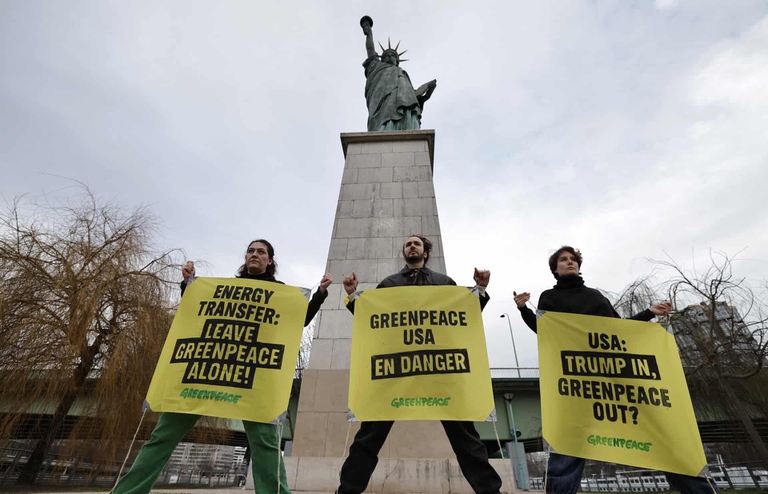
Greenpeace has suffered a bitter defeat in the United States. A court in the state of North Dakota has ordered the environmental organisation to pay a staggering financial penalty: 345 million dollars, equivalent to about 292 million euros. The Ngo was found guilty of defamation, sabotage, trespassing and deliberately interfering with the business operations of the American company Energy Transfer.
Greenpeace: “We may be forced to declare bankruptcy”
Greenpeace had already been convicted in 2025 in the same case at the first-instance level. At the time, the proposed penalty was even heavier: 660 million dollars. However, the reduction of the amount has not reassured the organisation. Its response was clear: “If the ruling is upheld, we will be forced to go bankrupt.”
PRESS RELEASE: Greenpeace organisations to appeal US$ 345 million North Dakota court judgment in Energy Transfer’s intimidation lawsuit https://t.co/swmS1tdlEj#politics#nzpol
Such a sum is financially unsustainable, and for the US branch of Greenpeace — founded in 1979 — the only option could be filing for bankruptcy.
Protests mobilised tens of thousands of people in North Dakota
The trial against the environmental organisation was linked to the protests against the Dakota Access Pipeline, which took place in the United States in 2016 and 2017. At the time, during Donald Trump’s first presidential term, around 300 Native American tribes mobilised tens of thousands of people to protest against the construction of the infrastructure — dubbed “the black snake” by the Sioux who live in one of the regions crossed by the pipeline. The project is a 1,800-kilometre pipeline capable of transporting about 750,000 barrels of crude oil per day from North Dakota to an oil terminal in Illinois.
According to the original plan, the pipeline would have crossed Lake Oahe, which provides water to the Standing Rock Indian Reservation and is considered sacred by the Sioux people. This sparked massive demonstrations. According to US courts, Greenpeace played a role in those protests. However, the NGO says its involvement in the mobilisation was marginal and insists that it never took part in violent actions, which it describes as “contrary to our ethics.”
Greenpeace will appeal to the Supreme Court — freedom of expression is also at stake
According to the judges, the wave of protests caused significant financial damage to Energy Transfer, and Greenpeace must therefore compensate the company responsible for building the pipeline. For the environmental organisation — which reports about 40 million dollars in annual revenue in the United States, mostly from donations — there is only one hope left: an appeal to the Supreme Court, first at the North Dakota level and then at the national level. “This ruling threatens the ability of movements like ours to speak out and tell the truth to those in power,” Greenpeace leadership said.
Energy Transfer, a Texas-based company, was able to rely on particularly favourable legislation in North Dakota. Unlike many other legal systems, the state allows Slapp lawsuits (Strategic Litigation Against Public Participation) — legal actions designed to silence critical voices.
In the 1930s, at a time when minority political representation in the US was extremely rare, proud Native American Charles Curtis became vice president.
We must listen to witnesses on the ground who are seeing abuse, duplicity, and the dereliction of duty firsthand. Our lives depend on their voices being heard. The op-ed by Sean Thomas, International Director of Investigations at Animal Equality.
Progressive, a Bernie Sanders supporter, of Puerto Rican origin: who is Alexandria Ocasio-Cortez, the youngest woman ever elected to the United States Congress.
Since the ceasefire began in mid-April, the Israeli military has killed at least 331 people in Lebanon. It is now intensifying both its air and ground attacks.
The European Commission has clarified that passengers are entitled to refunds for cancelled flights even in the face of high fuel prices. Airlines are also prohibited from adding retroactive charges to tickets already purchased.
On 22 March 2023, the European Commission advanced a Proposal for a Directive on Green Claims to address misleading sustainability claims and greenwashing.