


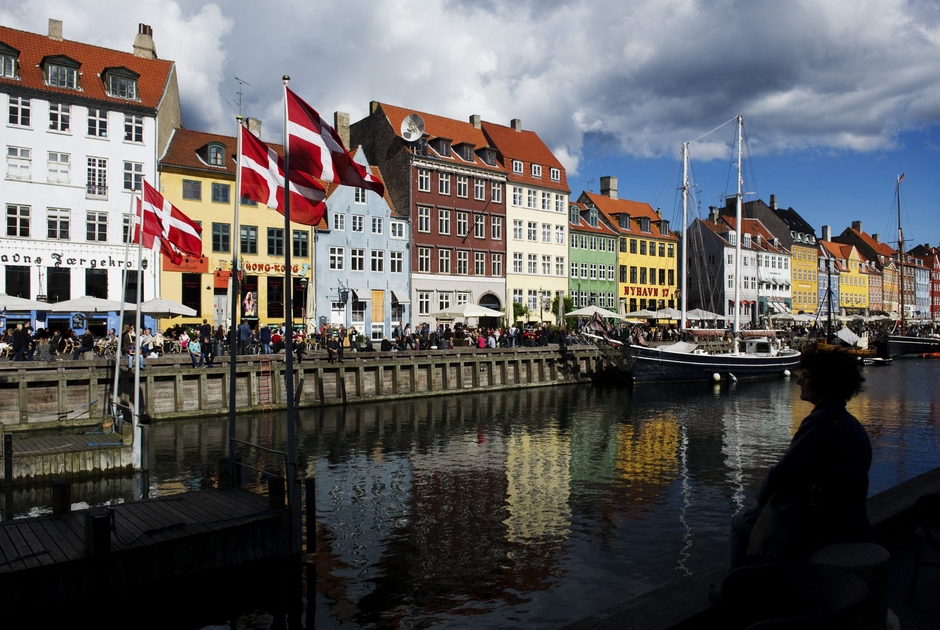
Copenhagen ranks first in the 2026 Global Liveability Index, followed by Vienna and Melbourne. Among the cities recording the greatest improvement in quality of life is New York.
From April 17 to 19, in Turin, the workshop brought together 24 industry professionals to promote an ethical approach to film production.
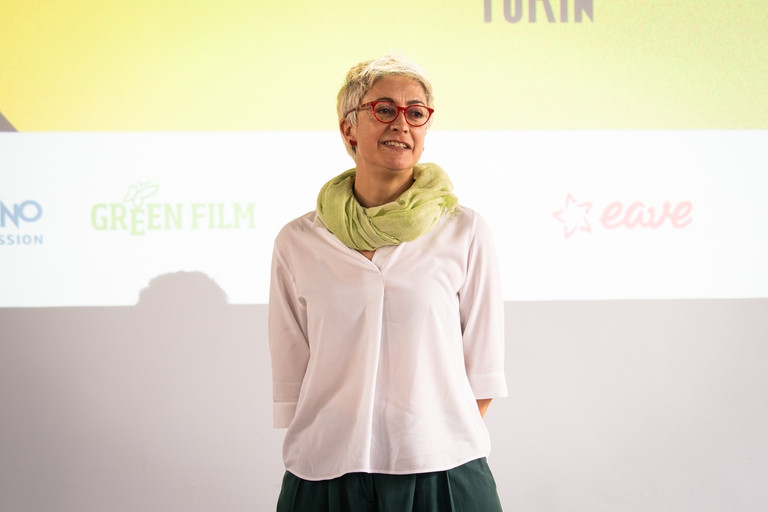
Three days of advanced training. TorinoFilmLab brought the Green Film Lab to Turin, an international project dedicated to filmmakers who want to produce films sustainably. Organized together with Green Film – Trentino Film Commission and with the support of Creative Europe – MEDIA Sub-programme of the European Union, the workshop was an opportunity to actively work on the environmental impact that films can generate, with the goal of applying a green protocol in the future and obtaining a certification.
The working experience was immersive. The participants (twenty-four in total, twelve from Italy and twelve from the rest of the world) had the chance to share their journeys and explain why environmental sustainability is a key issue in cinema today. Some said they were there because sustainability shouldn’t be an obligation, but something to engage with, almost crucial from a philosophical standpoint; others stressed that sustainability in production also comes through sustainability in content — that is, in the stories told.
The workshop opened with a general quiz led by Lucie Trémolières, a writer and director specializing in eco-storytelling, to gauge how much participants already knew about the topic. The idea was to break the ice, but above all to spark discussion within groups, even just to figure out which stage in a smartphone’s life cycle produces the most carbon dioxide. Spoiler: manufacturing.
Interestingly, at a certain point participants were split into two groups, each with its own tutor: Dörte Schneider Garcia, an experienced assistant director and sustainability consultant, and Louise Marie Smith, founder of Neptune Environmental Solutions, specializing in environmental management systems and sustainable practices for the high-end film and TV series industry.
The two groups were further divided into three smaller groups to work on individual projects. Each group of four included two people already involved in the project (the producer and the director) and two working on it for the first time (a producer and a sustainability consultant). The first part of the work was straightforward: look at the project, analyze it, and collectively identify the SWOTs (Strengths, Weaknesses, Opportunities, and Threats) along with all the critical environmental aspects needed to define a shared strategy. No solutions yet; the focus was simply on defining the problems and receiving feedback from the tutor and fellow participants to strengthen ideas, offer suggestions, or add context.
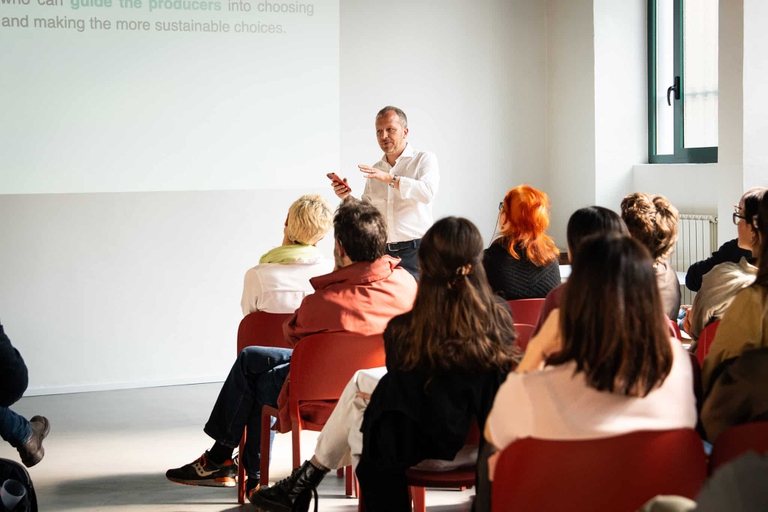
Before moving on to solutions, there was a masterclass on case studies, one that exemplifies the value of the training gained at the Green Film Lab. Everything followed a clear logic: group work, then a lesson, then more group work, then another lesson. The case studies illustrated a paradigm shift: how productions have transformed and reduced their environmental footprint. Some films replaced conventional lighting with LEDs, saving $10,000 in electricity; others swapped 243 liters of diesel for HVO (Hydrotreated Vegetable Oil), a high-quality renewable biofuel made from plant and animal waste, capable of reducing carbon emissions by 90% compared to traditional diesel.
“Lots of inspiring examples, even though every project has its own specifics,” recalls Giovanni Pompili, Head of Studies at Green Film Lab. “On top of that,” he adds, “what we try to do is use set materials that can be reused — so we’ve donated items to local communities, schools, or municipalities where museum or educational spaces have since emerged. You can also involve the crew in activities that benefit the local area. For instance, if you’re shooting a film in a coastal area, you might organize a beach clean-up. Another interesting topic,” Giovanni concludes, “is food and catering, because imposing a vegetarian menu doesn’t work. What you can do instead is apply a kind of reverse psychology. Rather than offering a meat-based menu and asking how many people are vegetarian, you offer a vegetarian menu and ask who wants meat. The goal is to make meat-eaters take an active role, and, in a sense, give them responsibility for their choice.”
The Green Film Lab also welcomed Luca Ferrario, Director of Trentino Film Commission and founder of Green Film, a tool developed to promote sustainability in audiovisual productions and guide producers toward certification. “What we value most, and what becomes fundamental for obtaining certification, is crew involvement and communication with department heads. By crew involvement, I mean keeping them informed about what is being done and why; not informally, but through a kick-off meeting where a plan is chosen and communicated to everyone. Often there’s no going back, because environmental sustainability brings economic sustainability along with it. And that’s plain for everyone to see.”
Sustainability (a term that is too broad and often overused, yet the most common and accessible) is a concept that, in cinema, must also pass through content, not just form. We met two directors who agree on this. For director and producer Maria Giménez Cavallo, already an assistant director to Abdellatif Kechiche and Pietro Marcello, humans are not at the center of the narrative. In her second feature, Piggy Baby, the focus is entirely on Mino, a piglet who becomes a family’s new pet. “In the film,” the director tells us, “I’d like to have Mino’s point of view; the story should start from the ground, with a running camera. I’d like lots of close-ups of Mino. It’s not about removing humans, but about showing that we are all aligned and intertwined.”
Tommaso Pitta‘s project, The Hottest Summer In History, also reveals a new interest in content. “This anthology film (divided into five stories),” the director explains, “takes place during an extremely hot summer, the hottest summer in history. A kind of metaphor, both literal and figurative, in the sense that we are living through one of the most confused and tormented moments in history. I interpret the decline of reason as something closely tied to the collective terror of being unable to do anything in the face of climate change. Each story in the film addresses an aspect of the climate crisis, and one of them also touches on the feeling that it’s a problem for the privileged — when it shouldn’t be, right?”
Siamo anche su WhatsApp. Segui il canale ufficiale LifeGate per restare aggiornata, aggiornato sulle ultime notizie e sulle nostre attività.

Quest'opera è distribuita con Licenza Creative Commons Attribuzione - Non commerciale - Non opere derivate 4.0 Internazionale.
Copenhagen ranks first in the 2026 Global Liveability Index, followed by Vienna and Melbourne. Among the cities recording the greatest improvement in quality of life is New York.
Even Cinema can reduce its ecological footprint, both in technical operations and in storytelling. TorinoFilmLab shows how.
Kyoto’s premier photography festival, Kyotographie, grows in stature with the launch of a new music festival, Kyotophonie, held in the spring and autumn.
The small state of Mizoram in northeast India has a thriving handicraft industry, with artisans making a living by selling products made from bamboo.
Many British cultural institutions have ended their relationship with oil giant BP in recent years, thanks to pressure from activists and the public.
Communities across India are celebrating Durga Puja, a festival that stands as an example of the communal unity which is under threat in the country .
Through stories of encounters between humans and animals, Our Wild Calling offers a way out of an age of solitude. We speak to author Richard Louv.
Survival, multiculturalism, plastic islands. Musician Grey Filastine recounts his adventure aboard the Arka Kinari, which set sail in 2019 and spent much of last year adrift in the Pacific because of the pandemic.
Chinese filmmaker Chloé Zhao made history, becoming the first Asian woman to win an Academy Award as well as a Golden Globe for Best Director for Nomadland.


